
Most Irish business owners come to this question wanting one number: how much to spend on Google Ads to make it work. It is a fair thing to ask when you have money on the line, but it is the wrong starting point, and the honest answer is more useful than a single figure.
The better question is how much you need to spend to gather data and compete in your own market. A plumber in rural Mayo and a solicitor in Dublin 2 are playing completely different games, so a global “average” budget tells you almost nothing. This guide gives you Irish benchmarks, a budget framework we use with our own clients, and frank guidance on total investment including the management fee.
- There is no universal Google Ads budget. Your spend is driven by your vertical, your location and how competitive the keyword auction is.
- Treat your first month as a data budget, money spent to learn, before you judge results. Underspending here wastes more than not advertising at all.
- Realistic Irish ad-spend ranges run from roughly €300 to €600/month for a small local business up to €1,500 to €5,000+ for competitive or e-commerce campaigns.
- Your total investment is ad spend plus a management fee. Budget for both from day one and keep a few months of runway.
- Your sales close rate matters as much as your cost per click. Great leads are wasted on a weak sales system.
Why There Is No Single Answer, and Why That Matters for Irish Businesses
When people ask how much to advertise on Google Ads, they expect a tidy figure. The problem is that cost per click (CPC), the price you pay each time someone clicks your search ad, swings enormously between industries and towns. Google runs a live auction for every search, and your position depends on your bid and your Quality Score, so two businesses can pay wildly different amounts for the same keyword.
This is why a number copied from a US blog is close to useless for an Irish SME. Our guidance here is built from the accounts we manage, not borrowed global averages, and the first thing to understand is how a tradesperson should actually frame the budget question.
I think the biggest issue we see with tradespeople asking about budgets and Google Ads is that they think every single Google Ads management service is the same. It’s vastly different. People who are experienced are worth the money because what they can do is they can get more jobs, better quality jobs for your budget, and effectively you’re paying them to optimise it over time.
I think there’s a bad connotation within the market currently where a lot of tradespeople will go for the cheapest option, but due to a lack of understanding of what Google Ads actually is and what it takes and how to optimise it and what good media buying looks like over the course of months and years. Also, yeah, regarding cost per clicks, cost per clicks are vastly different within industries.
For example, a plumber with super low competition in the west of Ireland, his cost per click might be for his main keyword search terms under a euro, whereas you go to Dublin and it instantly jumps up three times or four times that. Similarly, if you’re dealing with higher ticket jobs, like for example, home extensions or companies who do golf course renovations, you could be paying hundreds of euros per lead.
Another thing that we’ve seen is particularly in the insurance industry, like accident insurance business, like companies, because the claims can be so high, the cost for a click can be hundreds of dollars. So that’s something to be aware of. Really, I think it’s just an understanding, like modeling it up, using the tools that Google has available, like Google Keyword Planner and Search Forecast Planner, that will enable you to get a rough estimate of what you need to spend, how many clicks you’re gonna get, what’s the projected cost per conversion is, and then you can work up your pricing based on that.
I think another big one here is, and something I always ask my clients is, what is their sales close rate? If their sales close rate is ten percent and I’m sending them a couple of hundred leads a month, they might only get twenty sales out of that, and if they’re getting a cost per click that’s too high for them, then they might not even be making money off what they’re doing.
That it’s, it’s both a ads problem, but it’s also a sales problem. They need to have a working good sales system so that they can achieve thirty percent, forty percent or even higher sales close rate.
That split between an ads problem and a sales problem runs through everything below. If you want this handled properly from the start, our Google Ads management Ireland service exists to model the budget, build the campaign and optimise it month after month rather than leaving it on autopilot.
On one painting account we manage, cost per lead varied roughly sixfold across neighbouring areas after we switched to named-city targeting, from about €35 in the best area to over €230 in the weakest.
Sink or Swim Marketing, managed campaign data
The Two Budgets You Actually Need: Data Budget vs Growth Budget
The framework we use with every new client splits your money into two phases. Most budget guides skip this entirely, which is why so many Irish businesses pull the plug just before their campaign starts to work.
This is a big one that I see with the business owners. They don’t understand the timeline of how long it takes to build and optimise accounts. Month one should be purely about testing, and any budget that is decided should be seen as budget that is gone without any real business. Typically, that’s not the case, and we see leads coming in with the first week.
But really, the funnel starts wide, and then the job of a media buyer or someone who’s managing ads account for an Irish business is to close that funnel through keyword optimisation, adjusting landing pages, pausing ad groups that aren’t spending or that are costing too much. So that is what month one should be about, and then you can make smart business decisions from then on.
Additionally, we need to spend a certain amount within accounts so that Google has enough conversions to understand who your customer is. The reason why that is, is Google works on an algorithm of matching your services to interests of people and demographics of people. Its job is to do that because it wants to have its search engine functioning to the point that people use it to find a high-quality service that they buy and that they use and that they are happy with.
In some ways, you need to trust the algorithm of what Google is doing, and in the first month, it might not bring you people who are interested totally in your company, but they’re interested in your services.
That’s an important distinction. The best thing you can do is once that happens is tell Google by making adjustments in your account that those type of conversions and those type of people are good. You can do that through bidding optimisation, such as increasing bids for certain demographics or genders or ages of people, and additionally adding keywords that are relevant to that initial search term that converted.
Like another big one here is actually having the data and understanding the data to do that. A lot of ad accounts are set up in a way that you can’t actually make smart decisions. You are kind of pigeonholed into a broad match campaign with broad match keywords, and you don’t have proper conversion tracking, so you don’t actually understand what’s working and what’s actually leading to good quality jobs. Then you are afraid to turn off things or change things because you don’t know what the impact of that is gonna be.
What Is a Data-Gathering Budget?
In our experience managing Google Ads for Irish SMEs, a campaign needs a minimum of several hundred euro over the first four to six weeks before Google has enough conversion data to leave the learning phase and bid intelligently. Campaigns paused before that point rarely generate anything reliable to act on.
Treat month one as the cost of finding out what works. You are buying clicks, searches and conversions that teach the algorithm, and you, which keywords, areas and audiences bring the right jobs.
What Is a Growth Budget?
Once you know your winning keywords, converting areas and realistic cost per lead, the growth budget scales what already works. This is where the compounding happens. On one painting account we manage, cost per tracked conversion came down from about €110 to the low €60s to low €80s as negative-keyword and targeting work stacked up month over month.
Why Underspending Is Often More Wasteful Than Not Running Ads at All
Spread €150 a month thinly across broad keywords and you get too few conversions for Google to learn from, so the algorithm never optimises and every click stays expensive. You pay for the data-gathering phase without ever finishing it. In that scenario you would have been better off keeping the money, because a starved campaign burns budget without producing the one thing that makes Google Ads profitable: clean conversion data.
What Drives Google Ads Costs? The Key Variables
Four levers decide what you pay. Understand these and the Irish google ads cost picture stops feeling random.
Industry and Keyword Competition
Keyword competition is the single biggest driver of CPC. The more businesses bidding on a term, the higher the price Google’s auction settles on. A niche service term with two bidders behaves nothing like a generic city-wide term fought over by dozens of companies.
Quality Score and Ad Rank
Quality Score is Google’s 1 to 10 rating of your keyword, built from three parts: expected click-through rate, ad relevance and landing page experience. It feeds directly into your ad rank, so a higher Quality Score can win a better position for a lower bid. Sharpening these three components is one of the most effective ways to lower your cost without touching your budget. Our guide on why Google Ads get clicks but no leads digs into the landing page side of this.
Campaign Type (Search, Display, Shopping)
Campaign type changes the whole cost model. Search ads charge per click and target people actively searching, so they usually carry the highest intent and the highest CPC. The Google Display Network (GDN) typically bills on CPM, cost per thousand impressions, so clicks look cheap but convert far less often. Shopping campaigns sit in between for retailers. For most Irish service businesses, Search is where the budget should start.
Search: high intent, pay per click
Display: cheap reach, CPM, low intent
Shopping: product feed for retailers
Geographic Targeting as a Budget Lever
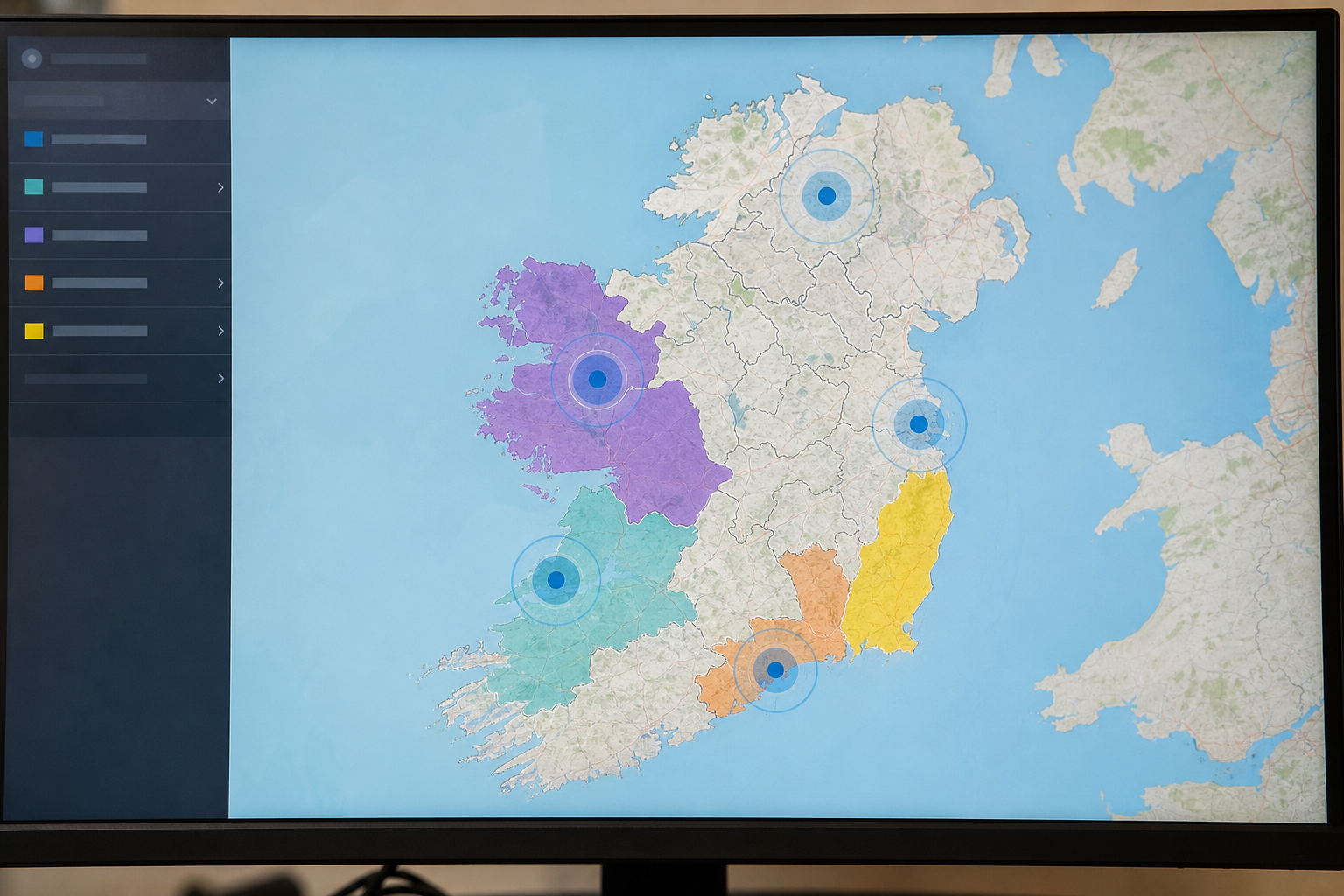
Where you show your ads is a budget control, not an afterthought. Tightening targeting from a broad radius to named towns or counties concentrates spend on areas that actually convert. As noted above, the same painting account saw a sixfold swing in cost per lead between areas once we targeted by name, which is wasted budget you reclaim just by choosing your map carefully.
Ireland-Specific CPC Benchmarks by Vertical (2026)
Below are indicative CPC ranges and the minimum monthly ad spend we would want to see to gather usable data in each vertical. These are Sink or Swim estimated ranges informed by Irish campaign experience and local auction behaviour. Treat them as a planning guide, not a quote, because your exact CPC depends on your keywords, Quality Score and area.
| Irish vertical | Typical CPC range | Competition | Min. monthly spend to gather data |
|---|---|---|---|
| Hairdresser / beauty | €0.50 to €1.50 | Low to moderate | €300+ |
| Plumber (rural / sub-niche) | €0.80 to €2.50 | Low | €300 to €500 |
| Painter / decorator | €2 to €5 | Moderate | €500+ |
| Roofer / home services (city) | €4 to €9 | High | €800+ |
| Paving / landscaping | €3 to €8 | Moderate to high | €700+ |
| Accountant / bookkeeper | €3 to €8 | Moderate to high | €600+ |
| Solicitor / legal | €6 to €20+ | Very high | €1,000+ |
| E-commerce (general retail) | €0.40 to €2 | Variable | €800+ |
| Financial services / insurance | €10 to €50+ | Extreme | €1,500+ |
| High-ticket (extensions, specialist) | €8 to €30+ | High | €1,500+ |
The spread here is the whole point. A rural sub-niche plumber and a Dublin solicitor are not in the same budget conversation, which is why the next section sets ranges by business tier rather than one headline figure. You can build these estimates yourself with Google’s Keyword Planner, which shows search volume and top-of-page bid estimates for your own terms.
If you’re in a sub-niche, so for example, within plumbing, let’s say you are just a heat pump installer, or you are just a person or business owner who does soil stack installations, those type of sub-niches still are quite cheap to use where the clicks could be under a euro because really the competition is just not there. You could be the one of two maybe competitors in the ad auction that are paying for those terms.
Whereas you move further into the city and more generalists, so for example, a plumber in Dublin, or for example, a roofer in Dublin, cost per click is massively high because you are potentially up against hundreds of companies who are competing against you for all the same search terms. Unfortunately, as time goes on and as population increases and more businesses are created and more businesses enter the ad auction, the price of the cost per click, cost per lead, unfortunately, at the start of any campaign goes up. It actually creates a harder barrier for entry and the margins are smaller.
Realistic Google Ads Budget Ranges for Irish Businesses
These are the google ads budget Ireland ranges we see working in practice, set against the vertical where they apply. Spend below the floor and you risk never leaving the learning phase.
Small Local Business (€300 to €600/month ad spend)
Works for lower-competition services and tighter geographies, a rural tradesperson, a single-location salon, a niche specialist. At this level you focus on a handful of high-intent keywords in a small area. It is enough to gather data and win genuine enquiries when the CPC is modest.
Growth-Stage SME (€600 to €1,500/month ad spend)
The right ppc budget Ireland band for most established service businesses competing across a town or county. Across the local-services accounts we manage, campaigns in this range have produced anywhere from a handful to 50-plus tracked conversions a month, with real lead volume running higher once off-platform phone calls are counted.
Competitive or E-commerce (€1,500 to €5,000+/month ad spend)
Needed for city-centre trades, legal and financial services, high-ticket work, or any retailer running Shopping at scale. Competition is fierce and CPCs are high, so the data budget alone can run past €1,500 before you reach efficiency. Our breakdown of real lead costs for Irish trades shows how these numbers behave for roofers, plumbers and electricians.
Total Investment: Ad Spend Plus Management Fee
Your true cost is two numbers, not one: the ad spend that goes to Google, and the management fee that pays for someone to run and optimise the account. Thinking of the fee as pure cost is a mistake, because good management is what lowers your cost per lead over time and wins you better jobs for the same budget.
So a growth-stage SME might plan for, say, €900 ad spend plus a management fee, and judge the whole package on cost per lead and close rate rather than on the fee in isolation. If you are weighing in-house against an agency, our comparison of hiring a Google Ads agency versus doing it yourself lays out the trade-offs.
You need to have a runway of a couple of months, so you need to be able to cover a minimum couple hundred euro for the ads and a couple hundred euro for the ad management company to manage your campaign. I would say you need to have enough runway in the business so that even if you get no sales within two months of running an ad, you can still keep business operations moving.
It’s very unlikely that that would be the case, but going back to systems, going back to your sales close rate, going back to being available and closing jobs in combination with running an ad account efficiently, that’s kind of what you need to prepare for. It’s very seldom that we would ever have an account that wouldn’t have leads coming in month one and at least a couple of sales in month one, but it can happen, and the worst thing we want to do is halfway through a campaign start pausing or changing things because the business owner is worried about cost.
How to Read Google’s Own Budget Recommendations (Without Getting Burned)
Google will cheerfully suggest you spend more. Its in-platform recommendations and “limited by budget” warnings are built to maximise reach, which is not the same as maximising your profit. Some suggestions are sound, others push broad match and raised budgets that inflate spend before your tracking is clean enough to tell what is working.
Read every recommendation against your own conversion data and cost per lead, not the optimisation score. If you do not yet have proper conversion tracking, ignore the prompts to spend more until you do, because scaling a campaign you cannot measure just multiplies the waste. It helps to understand how the Google Ads auction works so you can tell a genuine opportunity from an upsell.
Accept Google’s recommendations when they match your data and reject them when they do not. The platform optimises for its own revenue by default; your job, or your specialist’s, is to optimise for your margin.
Budget Optimisation: Should You Increase Spend or Improve Conversion Rate First?
When a campaign is working but you want more, the instinct is to add budget. Often the cheaper win is fixing conversion rate first, because every extra click lands on the same leaky page otherwise.
Negative keywords are central to this. Ongoing negative-keyword work is the single most important thing protecting a home-services budget, and we add them every week. On one painting account we layered in more than 130 negatives across seven sessions in a single month, with the cumulative block list running past 400 terms. That is budget waste removed before it ever becomes a wasted click.
Before you add budget, check these first
- Conversion tracking: Confirm calls and form fills are both tracked, phone calls are the primary channel for most Irish service businesses.
- Negative keywords: Review the search terms report and block waste before scaling it.
- Landing page experience: Make sure the page matches the ad and loads fast on mobile.
- Device and area splits: Check where conversions are cheapest and shift budget toward them.
- Then scale: Raise spend only on the keywords and areas already converting.
Seasonal Budget Adjustments for Irish Businesses
Demand in Ireland is seasonal, and your budget should move with it. Paving, landscaping and most outdoor trades ramp hard from spring into summer. On a paving account we manage, monthly clicks roughly doubled and conversions more than quadrupled heading into peak season, so holding budget flat would have left enquiries on the table. January brings a reset and a surge of planning searches, retail peaks before Christmas, and bank-holiday weekends shift when people search. The practical move is to lift budgets ahead of your busy window and trim through genuine lulls rather than spending evenly all year.
Underspending in your peak season is as costly as overspending in your quiet one. The calendar is a budget lever, so use it.
Ready to set a budget that works for your market?
We will model your spend, clicks and projected cost per lead against real Irish benchmarks, then build and manage the campaign so your budget compounds instead of leaking. Talk to a google paid ad specialist who manages Irish accounts every day.
Frequently Asked Questions
What is a good budget for Google Ads?
A good budget is one large enough to exit Google’s learning phase in your vertical, not a fixed number. For most Irish small local businesses that means roughly €300 to €600 a month in ad spend; growth-stage SMEs usually need €600 to €1,500, and competitive or e-commerce campaigns start around €1,500. Add a management fee on top. The right figure depends on your cost per click and the volume of conversions Google needs to optimise.
Is €20 a day good for Google Ads?
Around €20 a day, roughly €600 a month, is a workable starting budget for a lower-competition Irish service business in a tight area. It is enough to gather data and win genuine enquiries when your CPC sits under a few euro. In a high-CPC vertical like legal or insurance, though, €20 a day buys very few clicks and may struggle to leave the learning phase, so the answer depends entirely on your keyword competition.
How much should I expect to pay for Google Ads in Ireland?
Plan for two costs: ad spend to Google plus a management fee. Irish ad spend commonly runs €300 to €600 a month for a small local business, €600 to €1,500 for a growth-stage SME, and €1,500 or more for competitive verticals and e-commerce. Your CPC drives the detail, from under a euro for a rural sub-niche trade to €20 or more for solicitors and financial services. Keep a few months of runway before committing to a larger budget.
Is €100 a day enough for Google Ads?
For most Irish businesses, €100 a day, about €3,000 a month, is a strong competitive budget that comfortably clears the learning phase and lets you scale winning keywords and areas. It suits city-centre trades, legal, financial services and e-commerce at volume. For a small local business in a low-competition niche it is usually more than you need, and that spare budget is better invested in conversion rate and sales follow-up than in extra clicks.