
A roofing company outside Cork rang us last year, frustrated. They had set up Google Ads themselves after following a slick YouTube tutorial, spent about €1,800 over six weeks, and got two enquiries, neither of which was in Ireland. One was from a landlord in Manchester. The other never picked up the phone. The tutorial was American, the defaults were global, and nobody had told them that a brand new Google Ads account does not target the Republic of Ireland out of the box.
That is the gap this guide fills. Almost every Google Ads strategy (formerly AdWords) article you will read is written for markets with roughly ten times Ireland’s search volume and far denser competition. The tactics get copied straight over, and Irish SMEs quietly bleed budget to Belfast, London and Amsterdam. What follows is the strategic layer the global guides skip: the upstream decisions, in order, that decide whether your spend works here.
What Is a Google Ads Strategy, and Why Most Irish Campaigns Lack One
A Google Ads strategy is the chain of decisions that sits above the buttons: what outcome you are buying, which campaign type serves it, how the account is structured, how you bid, and how you measure success. Tactics are the buttons. Strategy is knowing which buttons to press and why.
Most Irish campaigns we audit are all tactics and no strategy. They have keywords, ad copy and a budget, but no clear line from a click to a booked job or a sale. That is why they feel busy and expensive at the same time.
Google Ads does not reward effort. It rewards structure. The account that wins is not the one that works hardest, it is the one that made the right five decisions before spending a cent.
The stakes have gone up. The cross-industry average cost per click on Search reached $2.96 in Q1 2026, up from $2.64 in Q1 2025. When clicks cost more, a loose strategy costs more too. Getting the structure right is no longer optional.
Step 1, Set Goals That Connect to Business Outcomes, Not Vanity Metrics
Every good Google Ads strategy starts with one question: what does a successful outcome look like for the business, in euro? Not clicks. Not impressions. A booked survey, a quote request, a phone call, a sale.
Pick a primary conversion action and put a rough value on it. If a painting job is worth €2,500 and you close one in four quotes, a quote request is worth about €625 to you. That number tells you what you can afford to pay for a lead, and it turns Google Ads from a cost into an investment decision.
Step 2, Choose the Right Campaign Type for Your Irish Market
Campaign type is the single biggest lever, and it is where imported advice does the most damage. A Shopping-heavy strategy that works for a US retailer with 50,000 monthly searches falls flat for an Irish tradesperson whose whole county produces a few hundred relevant searches a month.
Search vs Performance Max vs Shopping: Which Fits Your Sector?
Search is where high intent lives: someone typing “emergency plumber Galway” is close to buying. Shopping suits online retailers with a product feed. Performance Max hands Google’s AI the keys across all inventory, which can be powerful but reduces your visibility into what is working. Smart Bidding and Performance Max campaigns account for the majority of Google Ads investment in 2026. That does not mean it is right for you on day one. Google’s own campaign type documentation is the definitive reference for what each one does.
| Campaign type | Best for | Irish example | Min realistic daily budget | Control | AI reliance |
|---|---|---|---|---|---|
| Search | High-intent lead gen and services | Plumber in Galway, solicitor in Dublin | €20 to €30 | High | Low to medium |
| Performance Max | Ecommerce and multi-channel scale | Established online shop with sales data | €50+ | Low | High |
| Shopping | Product retailers with a feed | Irish homeware or fashion store | €30 to €50 | Medium | Medium |
| Display | Awareness and remarketing | Retargeting past site visitors | €10 to €20 | Medium | Medium |
| Video (YouTube) | Brand reach, top of funnel | Local brand building a name | €15+ | Medium | Medium |
The Irish Geo-Targeting Trap That Drains Budget on UK and European Traffic
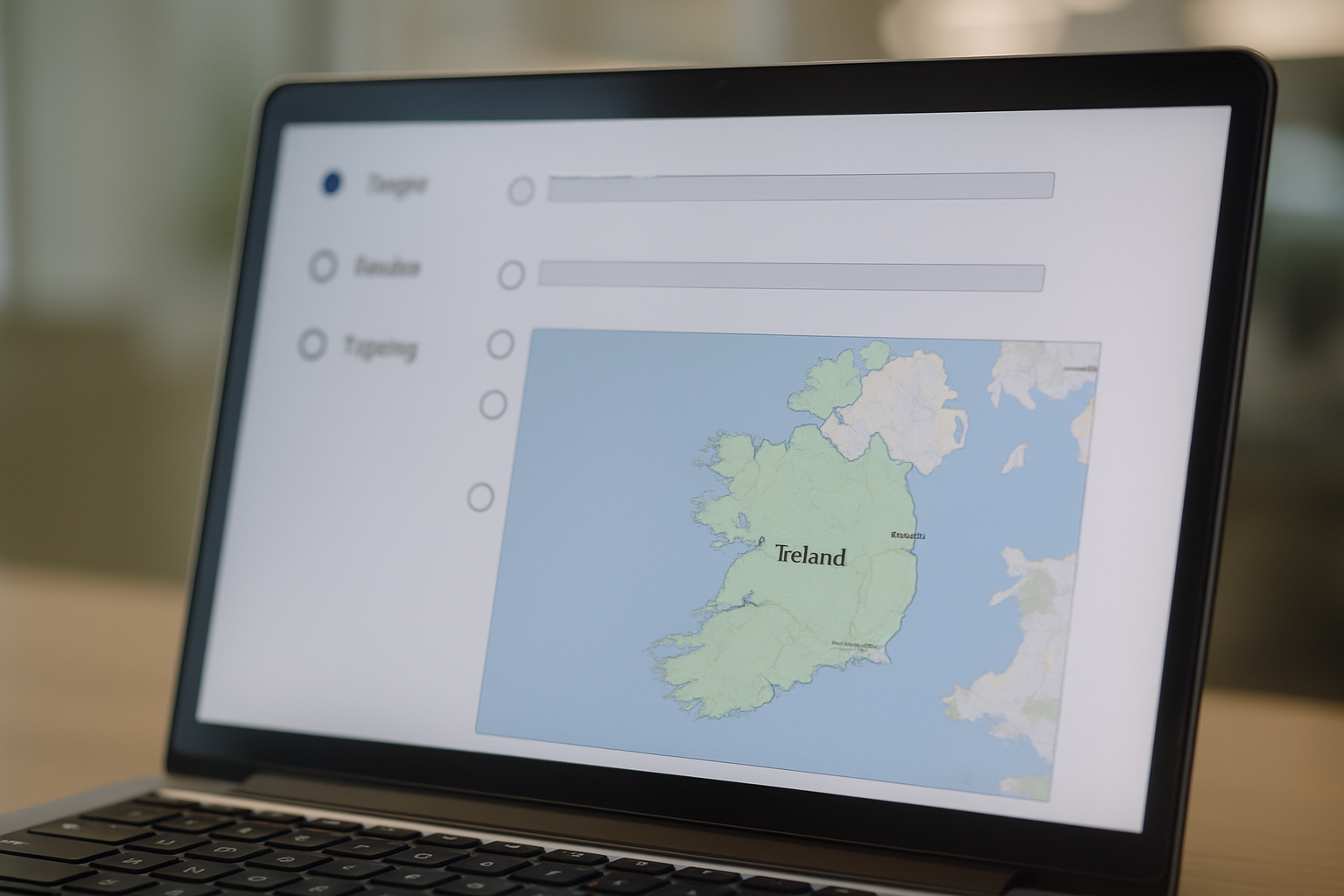
Here is the setting that costs Irish SMEs the most money. When you create a campaign, Google’s location targeting has a second option buried under “Location options”: target by Presence, or by Presence or interest. The default leans toward interest, meaning your ads can serve to anyone showing interest in Ireland, including someone in the UK reading Irish tourism content.
In our experience auditing Irish Google Ads accounts, a significant proportion of new accounts arrive set to “Presence or interest” rather than “Presence” only. For a local Irish business, that setting is almost always wrong. Set location to Ireland (or your county radius), then set the option to Presence: people in your targeted locations. This one change protects a huge share of a small budget. We walk through the exact steps in our guide to targeting Irish audiences with Google Ads location settings.
For local trades, we go further and run tight radius zones, adjusting bids area by area. Factors such as inflation and competition have caused search ads costs to rise over time, so wasting impressions on the wrong country is a luxury no Irish SME can afford.
Step 3, Keyword Research and Match Type Strategy for Irish Audiences
Keywords are still the backbone of a Search strategy. The trap in Ireland is volume: national keyword tools show numbers, but your addressable market is a fraction of that once you filter to your county and your service.
High-Intent Keywords and How Search Volume Differs in the Irish Market
Prioritise intent over volume. “Emergency electrician Dublin 8” has tiny volume but enormous intent. Build ad groups around tight themes so the ad matches the search. Once your core terms are stable, adjacent intent often unlocks the real growth. On one account we manage, testing broader “general contractor / remodeling” terms meant those adjacent keywords drove roughly 40% of all conversions within the first full month, with one of them becoming the single best converting keyword in the account.
Negative Keywords: Your First Line of Defence Against Wasted Spend
Negative keywords are budget protection, and they are not a one-off task. We add them every week. On one contractor account we layered in over 130 negatives across seven sessions in a single month, and the cumulative block list now runs past 400 terms. Every competitor name, unrelated trade and DIY “how to” query we block is a click we do not pay for, and you can watch the conversion rate climb as the list grows.
Step 4, Bidding Strategy: Which One Is Right at Your Stage?
Bidding is where “it depends” gets thrown around, so here is the concrete version: it depends on how much conversion data you have. Smart Bidding needs data to learn. Early on, you may not have enough.
Manual CPC vs Smart Bidding: When to Use Each
Advertisers using AI bidding strategies report 22% lower cost per conversion on average compared to manual CPC, but the advantage varies dramatically by industry and account maturity. That last clause matters in Ireland, where lower volumes mean the algorithm learns slowly. We often start new low-budget accounts on Maximise Clicks or Manual CPC to gather clean conversion data, then move to Target CPA or Target ROAS once there is a stable base.
| Bidding strategy | Best stage | Data needed | Risk | Recommended for |
|---|---|---|---|---|
| Manual CPC | Brand new account | None | Low | Tiny budgets, tight control |
| Maximise Clicks | Early, gathering data | Minimal | Medium | Building traffic and data fast |
| Maximise Conversions | After ~15 to 30 conversions | Moderate | Medium | Steady lead flow, no strict CPA |
| Target CPA | Established | High | Medium | Known cost per lead target |
| Target ROAS | Established ecommerce | High + revenue | Higher | Shops tracking sale value |
Bids also hide efficiency at the location level. We adjust bids area by area and stay patient: one zone gave us zero conversions for two months on a small positive bid, then produced two leads at a great cost in month three. Panic-cutting it would have missed them.
Step 5, Ad Copy, Assets, and Quality Score
Your ad and its Quality Score decide what you pay per click and where you rank. Quality Score improvement from 5 to 8 cuts CPC by roughly 30%. Copy is not decoration, it is a cost lever.
Writing Headlines That Convert for Irish Audiences
Lead with the outcome and the location: “Trusted Painters in Cork, Free Quote in 24 Hours” beats a generic “Quality Painting Services.” Read the asset report, not just the account total. On one painting account a “Commercial Painting” headline was converting at 20% and a big commercial enquiry came in the same month, which is the market telling you where demand sits. Our guide to creating compelling ad copy for the Irish audience goes deeper on tone and phrasing.
Ad Extensions (Assets) That Lift Click-Through Rate
Assets expand your ad, push competitors down and lift click-through rate for free. The rise in CTR across the market is partly driven by these. Use them all where relevant:
Sitelinks
Extra links to key pages, services, or your quote form.
Callouts
Short trust phrases: “Fully insured”, “20+ years”, “Free callout”.
Call assets
Tap-to-call, essential for phone-first trades and home services.
Structured snippets
List service types or areas covered so intent matches faster.
Location assets
Show your area, reassuring searchers you are genuinely local.
Image assets
Visual proof of work, particularly strong for trades and retail.
Step 6, Landing Pages and Conversion Tracking
Conversion tracking is non-negotiable. If you cannot measure a lead, you cannot optimise for it, and Smart Bidding is flying blind. This is the foundation everything else stands on, and it is worth understanding your Google Ads metrics properly before you scale spend.
The 2026 story makes landing pages the priority. High CTR plus low conversion rate (the most common 2026 pattern) points to a landing page problem, not an ad problem. Match the page to the ad, keep the form short, and put a phone number front and centre.
For trades and home services, phone calls are the primary conversion driver, not form fills. These customers are phone-first. We always put a tracking number on the landing page and count calls separately, because the people who tap “call now” are the ones booking jobs. On one account, 15 tracked conversions sat alongside 19 separately logged inbound calls in the same month, meaning the campaign was working harder than the dashboard alone suggested.
What Is the 7-11-4 Google Strategy and What Does It Mean for Your Ads?
The 7-11-4 idea, popularised from Google’s research into how people actually decide, is a rule of thumb: a buyer needs roughly 7 hours of interaction, across 11 touchpoints, in 4 separate locations before they trust you enough to buy. It reflects what Google calls the “messy middle.” The traditional marketing funnel suggests a tidy journey: awareness, consideration, purchase. But real life? Not so tidy. That’s exactly what Google’s Messy Middle framework explains. It recognises that modern buyers jump back and forth between researching, comparing and reconsidering before they decide.
For your Google Ads strategy, the implication is simple: a single Search ad rarely closes the deal on its own. Remember that buyers often revisit their research. This is where retargeting and consistent content come into play. A LinkedIn post today. A helpful article next week. A remarketing ad later on. Each interaction nudges someone further through the Messy Middle. Search captures intent, remarketing keeps you visible, and your content builds the trust in between. That is why we push a unified SEO and Google Ads strategy rather than treating ads as a standalone lever.
Is €20 a Day Enough? Realistic Google Ads Budgets for Irish Businesses
Yes, €20 a day can work for a focused local Search campaign, but only with realistic expectations. At €20 a day you are buying around €600 a month of clicks. In a lower-cost Irish vertical that is a decent trickle of leads. In a competitive one like legal or home improvement, it is a foot in the door, not a flood.
The month-to-month conversion-rate range on one of our managed Irish-market painting accounts. A single month tells you almost nothing.
Sink or Swim Marketing, managed account data, 2025 to 2026
Here is a real example of what focus does. When we took over a painting account spending a modest daily budget on a broad Search campaign, cost per tracked lead sat around the equivalent of €100. As negative-keyword and location work compounded month over month, it settled into the low €60s to low €80s. Same budget, far more leads. Separately, after one bid adjustment on an in-market audience, that account went from 2 conversions at roughly €190 each to 6.5 conversions at roughly €76 each in the next period, a lift of about 225% in conversions at around 60% lower cost per lead.
€20 / day
~€600/month. One tight Search campaign, one county, high-intent keywords only.
- Viable: local Search, remarketing
- Expect: a steady trickle of leads
- Not realistic: broad national reach or Performance Max scale
€50 / day
~€1,500/month. Multiple ad groups, tested copy, room for Smart Bidding to learn.
- Viable: Search + Shopping or PMax
- Expect: consistent lead flow, real optimisation data
- Not realistic: dominating a highly competitive national term
€100+ / day
€3,000+/month. Multi-campaign, multi-region, full asset and audience testing.
- Viable: full-funnel across campaign types
- Expect: meaningful market share, predictable pipeline
- Not realistic: hands-off “set and forget” success
For context, accounts spending under $5,000/month saw 18% higher CPCs and 31% lower conversion rates than the median. Small budgets are not doomed, but they demand tighter management, not less. If you are weighing the true cost, our breakdown of hiring a Google Ads agency versus doing it yourself in Ireland is a useful next read.
How Often Should You Update Your Google Ads Strategy?
Marketing campaigns should be adjusted for better results on a layered cadence: small optimisations weekly, structural reviews monthly, and full strategy reviews quarterly. Asking how often you should update your ad strategy has one honest answer, which is that the account never sits still, but the depth of the change scales with the timeframe.
Why not daily? Because the average conversion rate for Google Ads search is 3.75 to 4.40% in 2026, and at real budget levels individual keywords and headlines bounce around week to week. We judge assets over a rolling window, not a single report. One of our accounts swung from a 3.4% month to a 13.9% month within the same campaign. If you had panicked and gutted it after the weak month, you would have killed a winner.
Google Ads Review Cadence
- Weekly: add negative keywords, check spend pacing, catch anomalies, review search terms report.
- Monthly: review conversions and cost per lead, adjust bids by location and device, refresh underperforming ad copy.
- Quarterly: reassess campaign types, bidding strategy, budget allocation and audience strategy against business goals.
- Seasonally: plan for demand peaks. One paving account we manage roughly doubled clicks and more than quadrupled conversions heading into peak season.
Your Google Ads Strategy Audit Checklist (Self-Diagnose Before Calling an Agency)
Before you spend another euro, tick off the five foundations below. This is the same starting diagnostic we run on any new account. Be honest, then read the verdict.
Google Ads Strategy Self-Audit
Tick each foundation you genuinely have in place.
If you scored two or below, you are almost certainly leaving money on the table. The most common issues we see are catalogued in our guide to common Google Ads mistakes Irish businesses make.
Not sure where the leaks are?
As a google adwords services company working with Irish SMEs, we will review your account and show you exactly where budget is going and what to fix first.
FAQ
What is the best strategy for Google Ads?
The best Google Ads strategy is a chain of upstream decisions made in order: set a goal tied to a real business outcome, choose the campaign type that serves it, structure the account tightly, pick a bidding strategy that matches your data volume, and build conversion tracking before you spend. Tactics like keywords and copy come after those decisions, not before. For Irish businesses specifically, the single highest-impact move is correct geo-targeting so you are not paying for clicks outside your market.
Is €20 a day good for Google Ads?
Yes, €20 a day (roughly €600 a month) is enough for a focused local Search campaign in Ireland, provided your expectations are realistic. It buys a steady trickle of high-intent leads in a lower-cost vertical, and a foothold in a competitive one. It is not enough to dominate national terms or run Performance Max at scale. At small budgets, tighter management matters more, not less, because there is no room for wasted clicks.
What are the 4 strategies of marketing strategy?
The four core stages are awareness, consideration, conversion and retention. In Google Ads terms, awareness maps to Display and Video campaigns, consideration to remarketing and content-supported search, conversion to high-intent Search and Shopping, and retention to remarketing and customer-match audiences. A complete strategy uses different campaign types and success metrics for each stage rather than judging everything on immediate sales.
What is the 7-11-4 Google strategy?
The 7-11-4 rule of thumb suggests a buyer needs about 7 hours of interaction, across 11 touchpoints, in 4 different locations before they trust a brand enough to buy. It comes from Google's research into how people actually decide, described as the "messy middle" where buyers loop between exploring and evaluating rather than moving down a tidy funnel. For your ads, it means a single click rarely closes the deal, so pair Search with remarketing and consistent content to stay visible throughout the decision.
Work With an Irish Google Ads Agency That Thinks in Outcomes
Global tutorials will teach you the buttons. They will not tell you to change the one geo-setting that decides whether your budget stays in Ireland. That is the difference between running ads and running a strategy. As a Google Ads agency in Ireland, our whole job is the upstream decisions: goal, campaign type, structure, bidding and tracking, then relentless weekly optimisation on top.
If you want honest, practitioner-led PPC management in Ireland from people who have watched Irish SMEs burn thousands on a misconfigured setting, and want to make sure you do not, we are here for it.
Ready to make your Google Ads budget work in Ireland?
Book a free, no-obligation audit and we will show you exactly what to fix first.