
Right now, a Google Ads campaign set to its default location setting will happily show your ad to someone sitting in London who typed “best plumber in Dublin” into Google. That person is never going to ring an Irish plumber. But you just paid for the click. This one default, called “presence or interest”, is the quietest, most expensive mistake we see in Irish accounts, and almost nobody changes it.
This guide explains how targeting works in Ireland from the ground up: how Google decides where a user actually is, how to set location targeting that respects the border and county boundaries, how audience layers behave in a small population, and how to audit the whole thing so your budget goes to people who can actually buy from you - and if you want hands-on help, our Google Ads agency in Ireland covers all of this as standard. If you run Google PPC in Ireland, this is the page to fix your settings against.
- The default location trap: “Presence or interest” serving ads to people outside the Republic who merely searched an Irish term.
- The border problem: accidentally paying for clicks in Northern Ireland when you only serve the Republic.
- County and radius targeting: getting genuinely local without burning budget on the whole island.
- The small-population remarketing wall: why your remarketing list may never reach Google’s minimum threshold.
- Targeting leaks: reading your location report and search terms report to catch waste before it adds up.
The Targeting Mistake Most Irish Google Ads Campaigns Make
When you create a campaign and choose Ireland as your location, Google quietly applies a setting most advertisers never see. It decides not just who is in Ireland, but who has shown an interest in Ireland. Those are two very different audiences, and the difference is where the budget waste lives.
Google will happily spend your budget on users in Birmingham who searched an Irish term if you let it, and on the default setting, it will.
What “Presence or Interest” Actually Means
Inside the location options of every campaign, Google gives you a “target” setting. The default is “Presence or interest: people in, regularly in, or who’ve shown interest in your targeted locations.” That last clause is the catch. Someone in Manchester planning a trip to Galway, or an expat searching “Dublin estate agents” from Australia, counts as showing interest. Your ad shows. You pay.
The alternative is “Presence: people in or regularly in your targeted locations.” That serves only people physically in, or who habitually spend time in, the Republic. For the overwhelming majority of Irish service businesses, that is the setting you want.
negative keywords we layered into one home-services account in a single month, across seven sessions, with the cumulative block list running past 400 terms
Sink or Swim Marketing, first-party account data, 2025 to 2026
Negative keywords and the right location setting do the same job from two directions: they stop you paying for clicks that can never convert. In our experience auditing Irish accounts, location settings are the faster win because one toggle protects every keyword at once.
How to Switch to “Presence Only”, and Why It Matters in Ireland
The fix takes under a minute. In the campaign, go to Settings, open Locations, expand “Location options”, and under TARGET choose “Presence: people in or regularly in your targeted locations.” Save. Google’s own documentation describes both options in detail in its guide to location targeting.
Why it matters more in Ireland than in larger markets: Ireland is an English-speaking country with a global diaspora and a heavy tourism trade. A huge number of people abroad search Irish terms, far out of proportion to the population. Leave the default on and a meaningful slice of your spend drifts overseas. The country is small enough that this waste shows up fast in a tight budget.
| Presence or Interest (Default) | Presence Only (Recommended) | |
|---|---|---|
| What it does | Targets people in Ireland plus anyone who shows interest in Ireland | Targets only people physically in, or regularly in, Ireland |
| Who sees your ads | Irish users and overseas searchers using Irish keywords | Irish-based users only |
| Irish risk | Budget bleeds to London, Manchester, US and diaspora searchers who will never convert | Minimal geographic waste; spend stays in-market |
| When to use it | Tourism, hospitality, anything selling to inbound visitors | Trades, retail, professional services, almost all Irish SMEs |
How Google Determines Where Your Users Actually Are
Before you can trust your location targeting, you need to know how Google decides someone is “in Ireland” in the first place. It uses a blend of signals, not one.
📍 GPS & device location
On mobile, precise location services give Google a strong physical fix when the user has them enabled. The most reliable signal.
🌐 IP address
On desktop and where GPS is off, the IP address places the user in a region. Accurate at country level, looser on city, and easily skewed by VPNs.
🔍 Search signal & history
The query itself (“plumber Galway”) and a user’s recent activity feed the “interest” side of targeting, which is exactly what catches out the default setting.
The takeaway: because Google leans on the search signal and not just physical location, the only way to keep overseas searchers out is the presence setting. No amount of choosing “Ireland” as your country undoes the interest clause on its own.
Location Targeting Options for Irish Campaigns
Once the target setting is right, you decide how tightly to draw the map. Google gives you everything from the whole country down to a radius around a single Eircode.
Country, Region, and County-Level Targeting
You can target the Republic as a whole, or drill into counties and cities. County targeting matters in Ireland because demand and search behaviour are not uniform. A trade firm covering Cork city has very different competition and search volume to one covering Donegal, and bidding the same across both wastes money. We adjust bids area by area rather than treating the country as one block, and some zones need patience: one area gave us zero conversions for two months before producing leads at a great cost in the third.
For most local online advertising, target only the counties you actually service. If you fit kitchens in Leinster, there is no reason to show in Kerry.
Radius Targeting by Eircode for Local Irish Businesses
Radius targeting draws a circle of your chosen distance around a point, and you can centre that point on an Eircode. For a business with a fixed catchment (a clinic, a salon, a takeaway, a tradesperson with a 30 kilometre travel limit) this is far sharper than county targeting. Set the centre to your premises Eircode, pick a radius that matches how far you realistically travel, and you only pay for nearby searchers.
Run tight radius zones and adjust bids inside them. We have seen one zone sit at zero for weeks then deliver, so judge a radius over a rolling window rather than killing it on one quiet month.
The Republic vs. Northern Ireland: Handling the Border
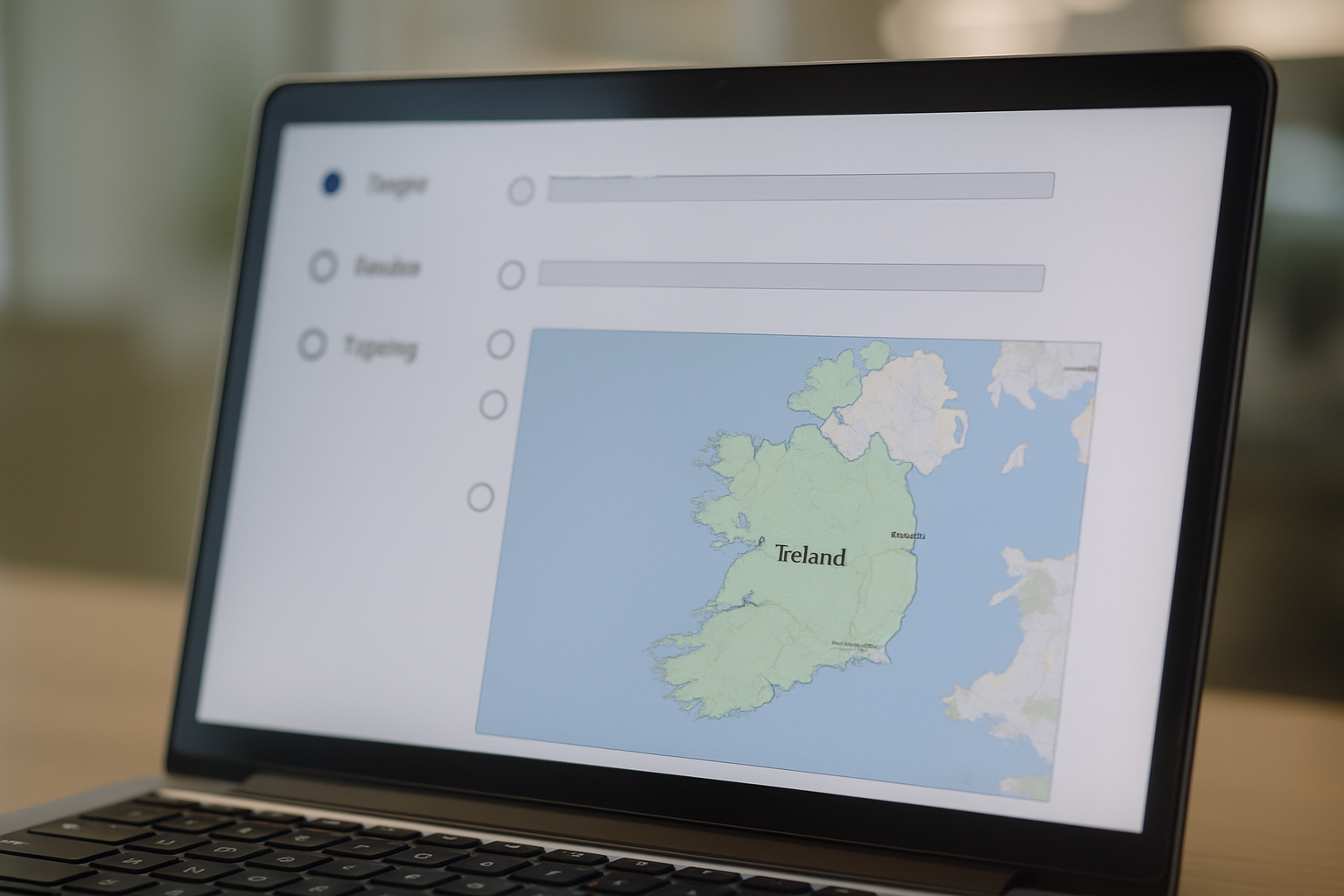
This is the Ireland-specific issue every generic guide ignores. If you target “Ireland” loosely, or use a radius near the border, you can spill over into Northern Ireland, a different jurisdiction with a different currency where your clicks rarely convert. To handle it cleanly:
- Target the Republic of Ireland as your location, not “Ireland” as a vague catch-all.
- Add Northern Ireland as a location exclusion so border-zone radius targeting cannot bleed across.
- Watch BT postcodes in your location report; BT is the Northern Ireland postcode prefix and a quick flag that you are spilling over.
Unless you genuinely sell across the border, the exclusion costs you nothing and protects every euro near Donegal, Cavan, Monaghan and Louth.
Audience Targeting Layers That Work for Irish Campaigns
Location decides where. Audience targeting decides who, layered on top. The catch in Ireland is population: layers that work fine in a country of 60 million can starve in a country of roughly 5 million.
In-Market and Affinity Audiences
In-market audiences are people Google has identified as actively researching a purchase right now (“Home Improvement”, “Mattresses”). Affinity audiences are broader, interest-based groups. For Irish campaigns, in-market audiences are usually the stronger lever because they map to live search intent. On one painting account we manage, after a bid adjustment the in-market “Home Improvement” audience went from 2 conversions at around $190 each to 6.5 conversions at around $76 each in the next period, a roughly 225% lift in conversions at about 60% lower cost per lead.
Remarketing Lists: The Small-Population Problem in Ireland
Remarketing shows ads to people who already visited your site. The problem is Google’s minimum: a remarketing list generally needs around 1,000 active users before it can serve on the Search and Display networks. In a country of about five million people, a niche local business can take a very long time to get there.
the total population of the Republic of Ireland, which is why a single-county SME often never fills a remarketing list to Google’s serving threshold
Population of Ireland per the Central Statistics Office
A small SME with strong footfall but a modest amount of web traffic can find its remarketing list simply never reaches the threshold. When that happens, we lean on in-market and affinity audiences for reach, tighten location and intent so every visitor counts, and let the list build over months rather than waiting on it. You can read the CSO’s geographic and population data at cso.ie.
Demographic and Device Targeting
Demographic targeting (age, gender, household income where available, parental status) lets you bias toward or away from groups. Device targeting matters more than most Irish advertisers assume. In home services the campaign is overwhelmingly mobile: on one account around 77% of conversions came from phones, yet desktop converted at almost the same cost per acquisition (about $75 each), so we keep modest positive bids on both rather than abandoning desktop.
Mobile is the default. Build the landing page for a thumb and a phone call.
Use ad scheduling to match Irish business hours and demand.
Set language to English (Ireland) to align with how locals search.
Language, Schedule, and Seasonal Targeting for Ireland
Language targeting in Google Ads filters by the language setting of the user’s browser and search, not the language of your keywords. For the Republic, English is the practical default. Setting language correctly keeps you aligned with how Irish users actually browse.
Ad scheduling lets you concentrate budget on the hours leads come in. The common assumption is that home-services enquiries arrive Monday to Friday. Not in our data: on one painting account the cheapest leads of the week came in at the weekend, with Saturday the highest click-through day and Sunday the lowest cost per lead. Test before you switch weekends off.
Seasonality in Ireland has its own rhythm worth bidding around:
☘ Paddy’s Week & spring
Late February into Patrick’s Day kicks off the home-improvement and outdoor-services season. Paving and landscaping demand climbs hard from here.
🏆 All-Ireland Final weekend
GAA finals weekends and big match days shift attention and traffic. Plan budget around the days people are watching, not buying.
☀ August Bank Holiday
A peak for outdoor and home projects. We have watched paving accounts more than quadruple monthly conversions into the late-spring and summer peak.
💰 January sales cadence
Retail and big-ticket purchases spike in the new-year sales window. Front-load budget where intent is highest.
How to Exclude Locations and Audit Your Targeting in Google Ads
Setting targeting once is not the job. Auditing it is. Two reports tell you whether your money is reaching Irish users, and both take minutes to read.
5-Step Irish Campaign Targeting Checklist
- 1. Set location target to “Presence only”: in Location options, choose people in or regularly in your locations, not interest.
- 2. Add your counties or Eircode radius: target only the areas you service, centred on your premises where catchment is fixed.
- 3. Exclude Northern Ireland: add NI as a location exclusion so border-zone targeting cannot spill over.
- 4. Set language to English (Ireland): align targeting with how local users browse and search.
- 5. Schedule to your demand pattern: match ad scheduling to when your Irish leads actually arrive, then test the weekend.
Reading Your Location Report
In the campaign, open Locations and then the “User locations” report. It shows where your ads actually served, not just where you intended. This is where you catch the leaks: clicks from outside the Republic, BT postcodes from Northern Ireland, or counties you do not serve. Anything that should not be there becomes an exclusion. Google explains the report in its documentation on location reports. Review it at least monthly.
Using the Search Terms Report to Catch Targeting Leaks
The search terms report shows the actual queries that triggered your ads. It is where you find irrelevant or out-of-market searches that no location setting catches, and you turn them into negative keywords. Ongoing negative-keyword work is the single most important thing protecting a home-services budget; we add them every week, and you can watch the conversion rate climb as the block list grows.
Location settings, location exclusions and the search terms report are three tools doing one job: keeping spend on people who can actually buy from you. Set them once, then audit monthly. That discipline is what separates a campaign that works from one that quietly leaks.
Is Your Google Ads Targeting Leaking Budget?
Answer four quick questions. Your score tells you how exposed your spend is.
Not sure your settings are right?
We audit Irish accounts for exactly these leaks every week. If your google local advertising is bleeding spend, we will find it. Talk to a Google Ads agency in Ireland that knows the border, the counties and the small-population pitfalls.
FAQ: Google Ads Targeting in Ireland
How does Google decide where a user is located?
Google blends several signals: precise device location or GPS on mobile, the IP address (accurate at country level, looser on city and skewable by VPN), and the search signal, meaning the query itself plus recent activity. No single signal is used alone, which is why the search signal can place an overseas user “into” your interest targeting even when they are not physically in Ireland.
What is the difference between “presence” and “interest” in Google Ads location targeting?
“Presence” targets only people physically in, or regularly in, your chosen locations. “Presence or interest”, the default, also includes people who have shown interest in those locations, such as someone abroad searching Irish terms. For almost all Irish SMEs, switch to presence only so you stop paying for overseas searchers who will never convert.
Can I target individual counties in Ireland with Google Ads?
Yes. Google lets you target the Republic, specific counties, cities, or a radius around an Eircode. County targeting is useful in Ireland because demand and competition vary widely between areas, so you can target only the counties you service and adjust bids area by area instead of treating the whole country as one block.
How do I target the Republic of Ireland without accidentally serving ads in Northern Ireland?
Target “Republic of Ireland” specifically rather than a vague “Ireland”, add Northern Ireland as a location exclusion, and watch for BT postcodes in your location report, since BT is the Northern Ireland prefix. This is especially important if you use radius targeting near border counties like Donegal, Cavan, Monaghan or Louth.
Why is my Google Ads remarketing list too small to use in Ireland?
A remarketing list generally needs around 1,000 active users before Google will serve it. In a country of roughly five million people, a niche or single-county business can take a long time to reach that. The workaround is to lean on in-market and affinity audiences for reach while the list builds over months.
How do I check if my Google Ads are actually reaching Irish users?
Open the “User locations” report under Locations in your campaign. It shows where ads actually served, not just where you intended. Look for clicks from outside the Republic or BT postcodes, and turn anything that should not be there into an exclusion. Pair it with the search terms report to catch irrelevant queries and review both at least monthly.
Work With an Irish Google Ads Agency That Knows These Pitfalls
Most of the waste in Irish accounts comes from settings nobody touched: the default location target, no border exclusion, a remarketing list that will never fill, a search terms report nobody reads. None of it is complicated to fix. It just takes someone who knows where Irish campaigns specifically leak.
That is the work we do every day. If you want Google Ads management in Ireland that starts by plugging the leaks before spending another euro, talk to our team. As a focused PPC agency in Ireland, we have brought cost per lead down and held strong impression share for trade, paving and retail clients by getting these fundamentals right first. See how our Google Ads agency in Ireland approaches account audits and ongoing management.
By the team at Sink or Swim Marketing
Irish digital marketing and Google Ads agency in Greystones, Co. Wicklow. We manage paid search for trade, home-services and retail clients across Ireland, and the figures in this guide come from our own managed accounts.