
Irish business owners are being told the same thing everywhere they turn: add an FAQ block, drop in some schema, write “conversational” content, and the AI tools will start quoting you. Most do exactly that. Almost none of them see results.
The reason is not their content. It is their website. Before any Generative Engine Optimisation tactic can work, the site itself has to be legible to the machines reading it: clean semantic HTML, a logical heading structure, fast load times, a crawlable page structure and clear entity signals. Bolting FAQ copy onto a structurally weak site is the digital equivalent of putting new signage on a building with no road access to it. This guide explains what actually drives AI citations for Irish business websites, and why so many are structurally invisible before the first word is written.
What AI Citations Actually Are (And Why They Matter More Than Rankings in 2026)
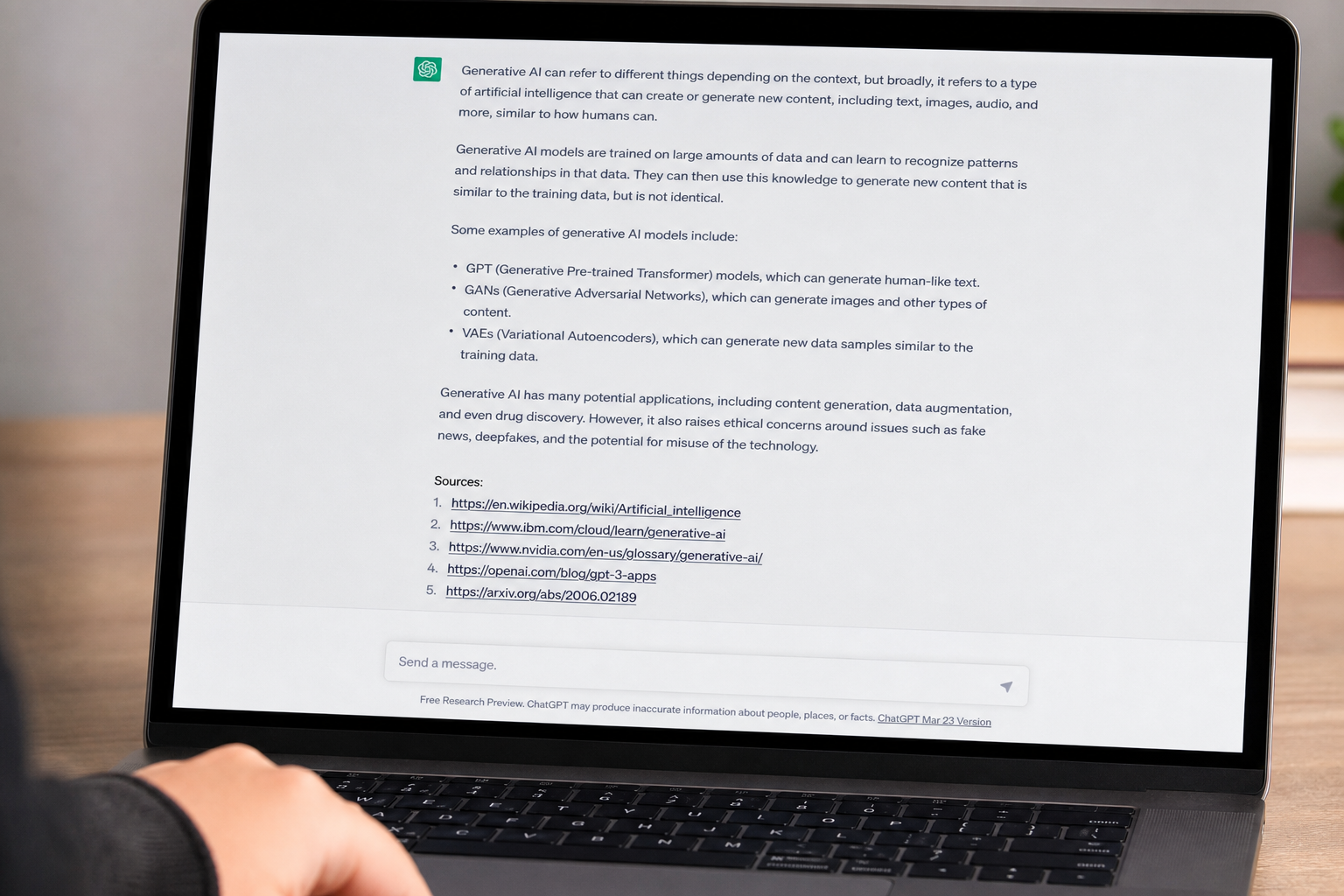
An AI citation is when a tool like ChatGPT, Perplexity or Google’s AI Overviews names your business, quotes your content, or links to your website inside its answer to a user’s question. It is the AI-era version of a first-page ranking, except the user often never clicks through. They read the answer and act on it.
This is the zero-click reality. When someone asks an AI assistant “who does bathroom renovations near Greystones,” the model synthesises an answer from sources it trusts and presents a short list. If your business is not one of the entities it can confidently extract and cite, you do not exist in that conversation, no matter how well you rank in classic Google results. That is why owned-site architecture and off-site authority now matter alongside traditional search engine optimisation Ireland work, rather than instead of it.
Ranking on page one used to be the finish line. In 2026, being the source an AI trusts enough to quote is the finish line, and a lot of Irish SME websites never make the starting grid.
GEO, AEO, and AI Overviews, Plain-Language Definitions
GEO (Generative Engine Optimisation) is the practice of making your business more likely to be selected, quoted and cited by generative AI systems. Think of it as SEO aimed at the AI answer layer rather than the ten blue links.
AEO (Answer Engine Optimisation) is the closely related discipline of structuring your content so it directly answers specific questions in a format an engine can lift cleanly, usually a clear question followed by a concise, factual answer.
AI Overviews is Google’s AI-generated summary that appears above the standard results. It began life as the Search Generative Experience (SGE), was rebranded to AI Overviews, and is now powered by Google Gemini. If you have seen a paragraph answer with citations sitting above the normal listings, that is it.
Which AI Platforms Irish Businesses Need to Care About
Google AI Overviews
AI summaries above Google’s results, powered by Gemini. The one Irish consumers encounter most, because it sits inside the search they already use.
ChatGPT
The most widely used standalone assistant, now with live web search. Business decision-makers increasingly use it for shortlisting and research.
Perplexity
An answer engine built around citations, showing sources prominently. Popular with researchers and detail-driven buyers.
Google Gemini
Google’s own assistant and the engine behind AI Overviews, deeply tied into Android and Google Workspace.
Microsoft Copilot
Bing Copilot, built into Windows, Edge and Microsoft 365, so it reaches office-based B2B users by default.
Claude
Anthropic’s assistant, common among professional and technical users who want careful, well-sourced answers.
For most Irish SMEs, the practical priority order is Google AI Overviews and ChatGPT first, because that is where local consumers and business buyers spend the most time, followed by Perplexity and Copilot for research and B2B contexts.
How AI Models Decide What to Cite
AI models are not choosing sources at random. They are pattern-matching against signals of trust, structure and corroboration that they learned during training and continue to weight when they retrieve live content. Four things do most of the heavy lifting: authority, structure, specificity and third-party corroboration.
Authority Signals: Why AI Trusts Some Sites and Ignores Others
Large language models learned what “credible” looks like from their training data, and that data heavily over-weighted established, editorially rigorous sources. AI language models learned credibility from training data that weighted high-authority, editorially independent sources, and publications with track records for accuracy, fact-checking and editorial standards were over-represented in the training corpora.
The practical implication is uncomfortable for owned websites. Comparative research emphasises that generative engines heavily weight earned media and often exclude brand-owned and social platforms, which implies that even high-quality pages may not be cited if they reside solely on vendor blogs. Your website has to earn its authority signals through consistency, structure and outside corroboration, not just self-declared expertise.
The Third-Party Citation Reality (And What It Means for Your Own Website)
The May 2026 edition of Muck Rack’s Generative Pulse analysed more than 25 million links from ChatGPT, Claude and Gemini responses across 17 industries, finding that earned media accounts for 84% of all AI citations, paid and advertorial content just 0.3%, and journalism alone 27% of cited sources. Those numbers have held remarkably steady: across all three editions going back to July 2025, earned media has ranged from 82% to 89%.
A press release drawn from that same data made the owned-domain figure explicit for an Irish audience. Brands publishing only on their own domains are competing for a significantly smaller share of citations, just 13.7 per cent according to MuckRack’s data.
Here is where most commentary stops, and where our argument begins. That 13.7 per cent of owned-domain citations is not a rounding error you should ignore. It is the slice you can actually control, and it only works if your website is structurally sound. Even when a business earns a third-party mention that triggers an AI citation, the AI still needs a credible owned website to send the user to. If your site is slow, unstructured and schema-free, the earned mention sends people to a page that fails to convert and fails to reinforce your entity. The two layers are not rivals. Owned architecture is the foundation the earned authority sits on top of.
Third-party earned media wins most AI citations, but your owned website is the destination and the corroboration anchor. A structurally weak site wastes every earned mention you fight to get. Build the foundation first, then amplify.
The Layer Every Competitor Misses: Website Architecture Comes First
Here is the argument we make as a web design and SEO agency that nobody else in this space is making: AI citation eligibility is an architectural decision made at the design and build stage, not a content afterthought. Sites built on shallow templated builders, with weak heading hierarchies, no schema, missing entity signals and slow load times are disqualified before a single FAQ is written.
Semantic HTML and Heading Structure, the Foundation AI Reads
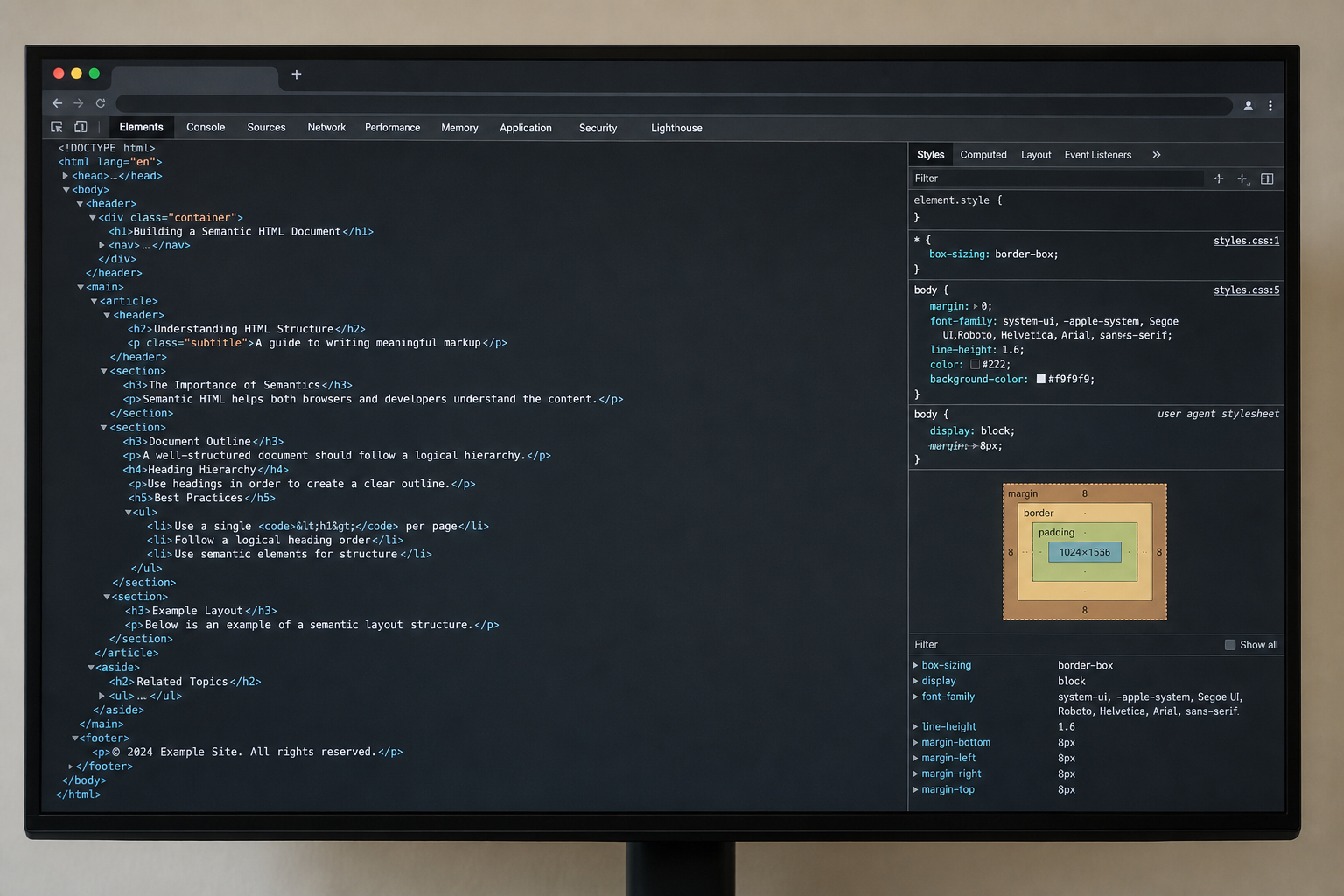
Semantic HTML means using tags for what they actually are: one H1 for the page topic, H2s for main sections, H3s for sub-points, real lists, real tables, proper article and section elements. This is how a machine understands the shape of your page and the relationships between ideas on it.
When heading tags jump from H1 straight to H4, or when everything is a styled div with no semantic meaning, the model has nothing clean to map. It cannot tell what answers what. In our web design audits of Irish SME sites, broken heading hierarchies are one of the most common reasons a page with genuinely good information still gets passed over. The information is there; the structure that makes it extractable is not.
Crawlability: If Googlebot Struggles, AI Will Too
Crawlability is whether search and AI bots can actually reach, read and index your pages. If content only appears after heavy JavaScript, if key pages are buried five clicks deep, if your internal linking is thin, or if important pages are accidentally blocked, then the crawlability that classic SEO depends on breaks, and AI retrieval breaks with it. The same bots that struggle to index your site will struggle to cite it. Clean internal linking and a logical site structure are not just user-experience niceties; they are the map the machines follow.
Page Speed as an AI Citation Signal (Not Just a UX Nicety)
Page speed matters twice. First, slow pages get crawled less thoroughly and less often, which reduces the fresh, complete content an AI can retrieve from you. Second, when an AI does send a user to your site, a page that takes six seconds to load simply loses them. Treating website performance as a foundation rather than an afterthought is how you make speed your ally in the AI answer layer, and it is why the link between website speed and digital marketing outcomes runs directly into your citation chances.
How Templated Builders and Thin Local Pages Disqualify Irish Sites
A lot of Irish small businesses delay web design investment because a €20-a-month page builder feels like “good enough.” The site looks fine to a human. Under the bonnet it is often a wall of nested divs, render-blocking scripts, duplicated thin location pages and zero structured data. To an AI crawler, that is noise.
The consequence is real. When Irish small businesses delay web design investment and rely on templated builders, they are not just accepting a slower site; they are opting out of AI eligibility entirely, because the page never presents clean, structured, fast content for a model to extract. This is exactly the gap that SEO services for Irish businesses and proper build work need to close together.
The Technical Prerequisites: Structured Data, Schema, and NAP
Once the architecture is sound, structured data is what turns a legible page into an explicitly labelled one. This is where the biggest quick wins usually sit for Irish SMEs, because so few have any of it.
Schema Markup, What to Implement and Why
Schema markup is a standardised vocabulary (defined at schema.org) that labels the meaning of content so machines do not have to guess. Instead of hoping an AI works out that “Sink or Swim Marketing” is an organisation in Greystones, structured data tells it directly. Getting schema markup right in Ireland is one of the clearest structural advantages available, precisely because so few competitors bother.
Organization / LocalBusiness
Names your business as an entity: name, address, phone, opening hours, logo. The backbone of local AI eligibility.
FAQPage
Marks your questions and answers as an extractable Q&A set, the single most direct trigger for AI answer extraction.
Article / BlogPosting
Labels author, publish date and publisher so the model can attribute and date your expertise.
Service / Product
Defines exactly what you offer and where, so “who does X near Y” queries can match you cleanly.
NAP Consistency Across Irish Business Directories
NAP means Name, Address, Phone. NAP consistency is having those three details identical everywhere they appear online: your website, Google Business Profile, and every Irish directory and listing. When the details match across sources, the AI gains confidence that your entity is real and stable, and that corroboration feeds directly into citation. When your address is formatted three different ways across five listings, you weaken the exact entity signal you are trying to build. Our complete blueprint for building local citations in Ireland walks through how to get this right directory by directory, and pairs well with a properly set-up Google Business Profile.
Content Formats AI Tools Prefer to Quote
With architecture and structured data in place, content format is what makes you the easiest thing on the page to lift. Two patterns matter most.
Answer-First Writing and FAQ Blocks
Answer-first writing means putting the direct answer in the first sentence, then elaborating. Lead with the fact, follow with the context. AI engines extract the clean, self-contained answer and use it. FAQ blocks are the purest form of this, and when paired with FAQPage schema they become a reliable extraction surface. The question is the query, the first sentence of the answer is the citation.
Specificity Over Breadth: The Lesson from Industrial Content
Vague claims are uncitable. Specific, verifiable claims are exactly what AI reaches for. Consider the difference between a generic Irish trade page and a citable one.
| Vague and uncitable | Specific and citable |
|---|---|
| “Expert plumbers in Dublin” | “Gas Safe registered plumbers serving Greystones to Dún Laoghaire since 2008, with over 340 completed jobs” |
| “We build quality patios” | “Paving contractor covering Wicklow and south Dublin, installing permeable SUDS-compliant driveways to Irish building standards” |
| “Trusted local electricians” | “RECI registered electrical contractor, emergency callout across Bray and Greystones, fully insured to €6.5m” |
The right-hand column gives an AI concrete, verifiable entities, credentials and locations it can attach to your business with confidence. Specificity is not just better copy; it is more citable copy. This principle applies whether you are a clinic, a retailer or a trade.
Self-Audit: Is Your Irish Business Website AI-Citation Ready?
Work through the checklist below and tick every item that is genuinely true of your website today. It scores out of 19 across the five layers of the citation stack. Be honest, because AI crawlers will be.
AI Citation Readiness Scorecard
From Invisible to Cited, How to Build for AI From the Ground Up
If you scored low, do not start with FAQ copy. Start at the bottom of the stack and work up. Here is the order that actually works.
The build-order roadmap
- Fix the foundation: Rebuild or repair site architecture so it uses clean semantic HTML, a logical heading hierarchy and shallow, well-linked crawlable page structure.
- Make speed your ally: Get page speed and Core Web Vitals passing on mobile, because slow pages are crawled and read less completely.
- Add structured data: Implement Organization, LocalBusiness, FAQPage, Article and Service schema so machines label your content instead of guessing.
- Lock down NAP: Make Name, Address and Phone identical across your site, Google Business Profile and every Irish directory.
- Rewrite for extraction: Convert key pages to answer-first content with genuine FAQ blocks and specific, verifiable claims.
- Earn outside authority: Pursue third-party mentions, press and quality directory listings, because earned media drives most citations.
- Measure and iterate: Track which queries surface you across AI Overviews Ireland and the major assistants, then refine.
Steps one to three are where a competent build actually changes the game. That is the layer only professional web design in Ireland and technical SEO can deliver, and it is exactly where most Irish sites fall down. Steps five and six are where owned and earned strategies compound. If you want to understand how the speed layer feeds the whole thing, our take on website performance and digital marketing results ties it together with the commercial outcomes.
Is your website structurally invisible to AI?
We build fast, schema-rich, semantically clean websites that AI engines can actually read, cite and send customers to. Let us audit yours.
Frequently Asked Questions
How do I increase my chances of being cited by AI tools?
Build from the foundation up. First make your website structurally legible with clean semantic HTML, a logical heading hierarchy, fast load times and a crawlable page structure. Then add structured data, answer-first content and consistent NAP signals, and finally pursue third-party earned mentions. Bolt-on FAQ copy on a weak site rarely works, because the AI has nothing clean to extract in the first place.
What is GEO (Generative Engine Optimisation) and how is it different from SEO?
GEO is the practice of making your business more likely to be quoted and cited inside AI-generated answers, while SEO is aimed at ranking in traditional search results. GEO overlaps heavily with SEO on fundamentals like site structure, speed and authority, but it adds a stronger focus on structured data, answer-first formatting and third-party corroboration, because AI engines select and cite sources differently from a ranked list of links.
What is Ireland's strategy for AI and how does it affect Irish business websites?
Ireland has actively backed AI adoption at national level. The Government published its updated Digital and AI Strategy in February 2026, while the AI Office of Ireland was established in July 2026 to coordinate implementation of the EU AI Act. The Government will also publish a new sectoral AI Adoption Strategy in 2026 with ambitious sectoral targets, and Enterprise Ireland will develop a differentiated AI Adoption Roadmap for its client companies. The practical upshot for your website is that more Irish consumers and buyers will use AI to research and shortlist, so being citable is becoming a mainstream visibility issue, not a niche one.
Does Ireland support AI adoption for small businesses?
Yes. Alongside the national strategy, dedicated SME support is being rolled out. A new Observatory for Business AI Readiness will track enterprise AI use in Ireland, and an AI and digital awareness and literacy campaign will target SMEs specifically. Adoption is climbing too: CSO data shows that 20.2% of enterprises in Ireland used artificial intelligence in 2025, compared with 8.1% in 2023.
Which industries in Ireland are seeing the most AI-driven search activity?
Adoption is heaviest in information and communication, finance and manufacturing. Information and communication has the strongest concentration of AI-related job postings in Ireland, and finance and insurance have high occupational exposure, with institutions building applications in risk, fraud detection and compliance. Manufacturing is a key target of Ireland's 2026 sectoral AI adoption strategy, and Fáilte Ireland's strategy includes accelerating AI adoption in tourism. For local service businesses, the shift shows up on the consumer side as more people using AI to find and vet providers.
Does website speed affect AI citation chances?
Yes, indirectly but meaningfully. Slow pages are crawled less thoroughly and less often, which reduces the fresh, complete content an AI can retrieve from you, and when an AI does send a user to a slow page they often leave before it loads. Treating website performance as a foundation rather than a finishing touch is part of making your site eligible to be read, extracted and cited.
What schema markup should an Irish business website have?
Start with Organization or LocalBusiness schema to establish your entity, name, address and phone. Add FAQPage schema on your questions and answers, Article or BlogPosting schema on your guides, and Service or Product schema to define what you offer and where. This structured data, defined by the schema.org vocabulary, tells machines what your content means instead of leaving them to guess.
Is a website on a page-builder like Wix or Squarespace less likely to be cited by AI?
Not because of the brand name, but because of how such sites are often built. The risk is bloated code, render-heavy templates, weak heading structure and missing schema, all of which make content harder for an AI to read and extract. A page builder configured carefully with clean structure, proper schema and good speed can be fine; a default templated build that is slow and structureless will struggle. The determining factor is the underlying architecture, not the logo on the platform.