
Picture the day you open a second location in a county where nobody has heard of you. On day one you have zero organic authority there, no reviews tied to that address, and no map pack presence. This is the exact moment where the local SEO and ads combo earns its keep. Google Ads buys you immediate visibility while your organic footprint is still nil, and the search term data those ads hand back tells you precisely which local keywords to build content around. As your organic rankings climb, your cost-per-click falls, and you rebalance budget from paid to content. That feedback loop is the whole idea of this page.
Most Irish businesses run local search seo services and paid ads in two separate rooms, managed by two separate people, judged on two separate reports. That siloed setup quietly leaks money. Combining local SEO and ads into one system built on shared infrastructure is how multi-location operators actually achieve local search dominance across counties, not just in their home town.
Treat local SEO and Google Ads as one compounding system, not two channels. Your Google Business Profile, your location landing pages and your search intent data are shared infrastructure both channels draw from and feed back into. Lead with ads when you enter a new county with no authority, use the ad search term data to shape SEO content, and rebalance budget toward organic as rankings hold and CPC drops. For multi-location Irish operators, the extra discipline is preventing your own branches from cannibalising each other in the auction and in the map pack.
Why Treating Local SEO and Google Ads as Separate Silos Is Costing You
The single most common mistake we see in Irish local online marketing is running SEO and paid ads as isolated projects. The SEO team optimises the Google Business Profile and writes location pages. The ads team runs campaigns and buries a goldmine of search term data inside an account nobody on the SEO side ever opens. Neither knows what the other is learning.
That silo costs you twice. First, you pay full CPC forever because you never let organic rankings take pressure off the paid budget. Second, you write SEO content based on guesswork instead of the exact phrases real customers typed before they converted, which is where a solid local SEO strategy in Ireland makes all the difference. When the two channels talk to each other, every euro of ad spend becomes market research for your SEO, and every organic ranking gained becomes a discount on your next click.
Ads tell you what people actually search and buy today. SEO turns that intelligence into an asset you stop paying rent on. Run them apart and you throw away half of each.
For a single-location shop this is inefficient. For a multi-location operator running four, six or ten branches across Dublin, Cork, Galway and the counties in between, the silo is expensive at scale, because every mistake is multiplied by your location count.
The Compounding Loop: How SEO and Ads Share Infrastructure
The reason combining local SEO and Google Ads outperforms either alone is not that you are doing two things at once. It is that the two channels draw from the same underlying assets and feed results back into each other. Get the loop turning and results compound instead of adding up.
Google Business Profile, The Connective Tissue
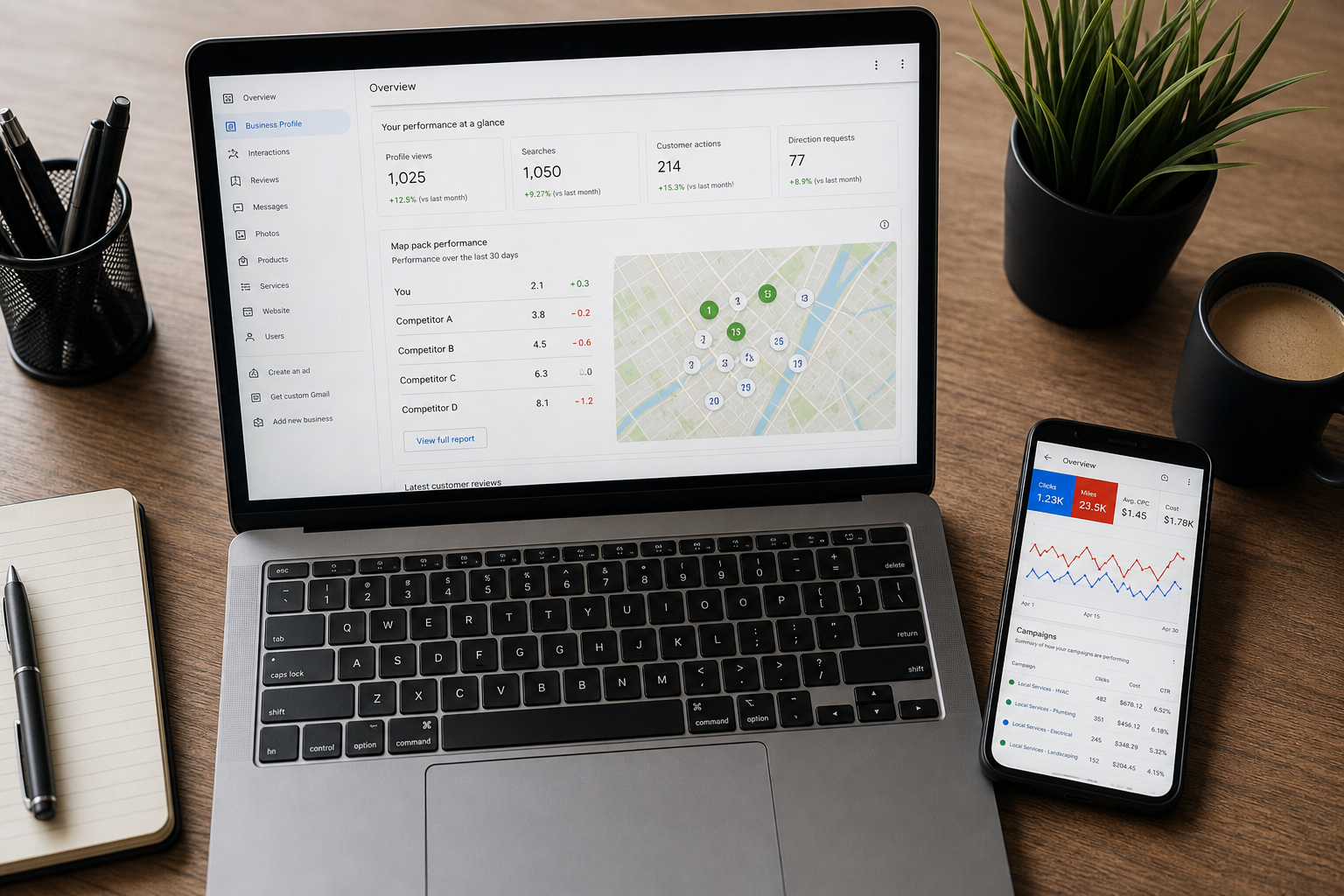
Your Google Business Profile is the one asset both channels stand on. It powers your position in the local 3-pack organically, and it supplies location assets and call extensions to your local Google Ads. A well built profile with consistent NAP, accurate categories, regular posts and a healthy review velocity lifts organic map pack rankings and improves ad relevance at the same time. Google’s own Business Profile guidance is the baseline here, keep every location’s details identical across your citations so the entity stays clean.
How Ad Search Term Data Accelerates Local SEO
The ads search terms report is the fastest, most honest keyword research tool in existence, because every phrase in it comes from someone who actually searched and, often, converted. We mine it for the exact local keyword targeting to build location pages and blog content around. Search intent is not guessed, it is measured. When we launch a new county for a client, the first weeks of ad data effectively write the SEO brief.
How Organic Rankings Reduce Your Cost-Per-Click Over Time
Once you hold map pack and organic positions, you can dial paid spend back on the terms you now win for free, concentrate budget on higher intent and competitive terms, and let cost-per-click settle. In our experience with Irish multi-location clients, CPC reductions of roughly 20 to 40 percent on core service terms are achievable once map pack positions are held for 90 days or more, which frees budget to reallocate from paid toward content and local seo management.
Lift in monthly conversions we achieved for a managed local-services account after a single bid adjustment on an in-market audience, at roughly 60 percent lower cost per lead (from about €190 to about €76 per lead in the following period).
Sink or Swim Marketing managed account data, 2026
That kind of swing is only possible when someone is reading the data and acting on it weekly. If your ads run on autopilot and your SEO runs in a separate spreadsheet, the loop never closes.
What Local SEO for Scaled Operations Actually Is
Local SEO is the practice of ranking a specific physical location for searches with local intent, in the map pack and in organic results, driven by your Google Business Profile, citations, reviews and location pages. Multi-location local SEO Ireland just means doing that repeatably and without the branches undermining each other. It differs from general SEO because the ranking signals are geographic and entity based rather than purely content and link based.
The Multi-Location Challenge: Dominance Without Cannibalisation
Running several branches introduces a problem a single-location business never faces. Your own locations can compete against each other, in the ad auction and in the organic map pack. Solving that is the difference between real local search dominance and a fleaky, self-defeating spend.
County-Level Targeting and Eircode Geo-Fencing
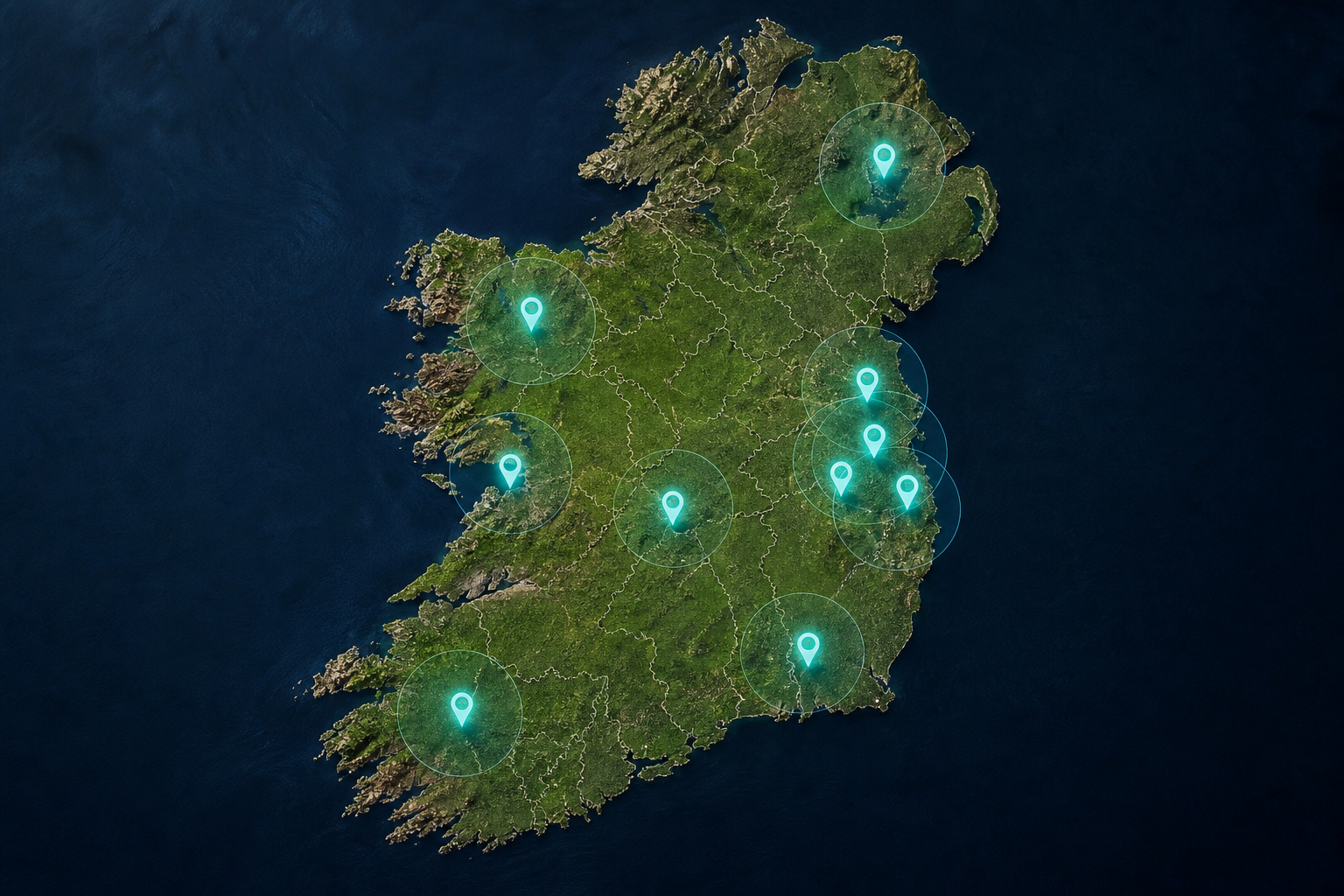
Irish geo-targeting rewards precision. Rather than a blunt radius that overlaps two branches, we set county-level targeting and tighten it with Eircode based geo-fencing so each location owns a defined catchment. This stops your Galway branch bidding on searches your Limerick branch should serve, and it keeps each location page mapped to a real, non-overlapping service area.
Location-Specific Landing Pages That Serve Both Channels
Every branch needs its own landing page, and that page does double duty. It is the organic asset that ranks for the town and county, and it is the ad destination that carries Quality Score and converts paid clicks. One page, both channels, consistent NAP, embedded map, local reviews and genuinely location specific copy, not a template with the town name swapped in.
Avoiding Ad Auction Cannibalisation Between Your Own Branches
Cannibalisation is when two of your locations enter the same auction and bid your own price up. We prevent it with strict geo-targeting boundaries, shared negative keyword lists that separate location territories, and, where appropriate, a single account structure with location targeting rather than duplicate campaigns fighting each other. The interaction between local SEO and Google Ads for Irish businesses is exactly where this discipline pays off.
Overlap Audit
Map every branch catchment before launch and flag any postcode two locations both target.
Shared Negatives
A central negative keyword list that fences each location’s territory and blocks internal bidding wars.
One Clean Entity
Identical NAP across GBP and citations per branch so Google never confuses one location for another.
Strategic Sequencing: When to Lead With Ads, When to Let SEO Drive
The question that actually matters is not SEO or ads. It is what to lead with and when to rebalance. A new county with no authority needs ads first. An established branch that already owns the map pack needs SEO to defend and ads only to fill gaps. Here is the three phase sequence we run.
Phase 1, Ads-Led Launch (Months 1 to 3)
You have no organic authority in the new county, so ads carry the load. The goal is immediate enquiries plus clean search term and conversion data. When we launched a new location for a home-services client, ads generated the first tracked enquiries and, just as valuably, handed us the exact search phrases to build the location page around. First-quarter ramps on our new accounts typically see leads roughly triple and cost per lead more than halve as the account moves out of the learning phase into tightly sculpted high-intent targeting.
Phase 2, SEO Builds Authority, Ads Get Smarter (Months 4 to 9)
Now the location page, GBP optimisation and review velocity start earning organic map pack positions. Ads keep running but get smarter, informed by which terms convert and which counties perform, so budget concentrates on high-value geography. This is the phase where review management and local link building do heavy lifting.
Phase 3, Compounding Returns and Budget Rebalancing (Month 10+)
Organic now covers the terms you used to buy. You pull paid spend back on those, hold CPC down, and reallocate budget toward content and local seo management that keeps compounding. The location that cost you a full ad budget to launch now runs on a fraction of it while enquiries hold or grow.
Sequencing Checklist Per New Location
- Launch ads first the moment the branch opens, with county-level targeting locked to its catchment.
- Harvest search terms weekly and turn converting phrases into the location page brief.
- Build the location page and GBP together so both channels share one clean, consistent asset.
- Drive review velocity to lift map pack rank and ad relevance at once.
- Rebalance budget once positions hold for 90 days, moving spend from paid to content.
Choosing Your Approach by Scenario
Not every branch needs the same mix. This is how the integrated model outperforms an SEO-only stance across the four situations Irish multi-location operators actually face.
| Scenario | SEO Only | Ads + SEO Integrated |
|---|---|---|
| New location, new county | Months of silence with zero visibility while authority builds | Immediate enquiries from ads, plus data that shapes the SEO from week one |
| Established branch defending rank | Vulnerable to any competitor who simply buys the top of the page | Organic holds the map pack, ads defend the paid slots above it |
| Competitive urban market (Dublin, Cork) | Slow to break into a crowded 3-pack | Ads win share now while SEO grinds out durable organic position |
| Rural or county-town market | Can work well but slow, and thin search volume hides intent | Even small ad volume reveals real local search patterns fast |
Not sure which phase your locations are in?
Tell us how long each branch has been open, whether it ranks in the map pack, and your monthly ad budget, and we will map the sequence for you.
Irish-Specific Nuances No Generic Guide Covers
A generic international guide cannot replicate this section, because it does not understand how Irish people search or how Irish geography carves up demand. This is where local online marketing stops being a template.
Bilingual Search Behaviour (Irish and English)
In Gaeltacht areas and among Irish-language businesses, searches mix English and Irish terms, and place names appear in both forms. If your location sits in or near a Gaeltacht, your keyword targeting and GBP categories should account for both languages, and your ad copy should not assume English-only queries. Most generic guides never even raise this.
County and Town Search Patterns Across Ireland
Irish searchers lean heavily on county and town names rather than the American style “near me”. People search “electrician Wicklow” or “physio Naas”, not just “electrician near me”. Across our Irish client base we consistently see a strong share of location-specific queries carrying the county or town name, a pattern distinct from UK and US behaviour, which is why county-level targeting and town-named location pages matter so much here. It also shapes how we write meta titles and descriptions for local rankings in 2026.
Tracking the Integrated System: What to Measure and When
You cannot manage a compounding loop you are not measuring. The point of integrated tracking is to see how the two channels affect each other, not to report them in isolation.
Blended cost per lead
Count phone calls, not just form fills. On our home-services accounts calls consistently match or outrank forms, and the real cost per contact often runs at less than half the dashboard’s tracked figure.
Map pack position over time
Track per location. This is your signal to start pulling paid spend back on won terms.
CPC trend per term
Watch cost-per-click fall on terms you now rank for organically, that is the loop working.
Impression share by location
Flags cannibalisation early and shows whether a branch is winning its own auction. One managed account held the top impression share in its local set, overtaking national lead-gen platforms.
Because tracked conversions reliably understate real volume, robust call tracking is essential. On one managed account 15 tracked conversions sat alongside 19 separately logged inbound calls in the same month, so a report reading only the ads dashboard would have badly undersold performance.
How AI Overviews and SGE Change the Equation
AI Overviews are reshaping what the organic results page looks like, pushing traditional blue links further down and summarising answers above them. That is exactly why the local SEO and ads combo is now a visibility hedge, not a nice-to-have. When AI Overviews compress organic real estate, holding both a strong map pack presence and a paid position keeps you visible no matter how the layout shifts.
Local intent is also more defensible than general informational search, because AI still leans on Google Business Profile data, reviews and proximity to answer “who can do this near me” queries. Keep your entity clean and your reviews flowing, and run ads as insurance against layout volatility. SEO is not dead, it is being restructured, and the businesses that pair it with paid visibility are the ones who stay on the page.
Frequently Asked Questions
Does local SEO still work in 2026?
Yes, and for local intent it works better than ever. Google still ranks the local 3-pack on Business Profile quality, reviews, proximity and NAP consistency, and those signals are not replaced by AI Overviews. Multi-location businesses that keep clean profiles, town-named location pages and steady review velocity continue to win map pack visibility. The change in 2026 is that local SEO performs best paired with paid ads as a hedge against a shifting results layout, not on its own.
Is SEO dead or evolving in 2026?
Evolving, clearly. AI Overviews and SGE are restructuring how results are displayed, summarising answers and pushing links down the page. That reduces some informational click volume, but local and commercial intent stay strong because Google still leans on Business Profile data, reviews and proximity to answer local queries. The winning move is to keep investing in local SEO while running Google Ads for guaranteed visibility, so a layout change never wipes out your presence overnight.
What is the 80/20 rule for SEO?
It is the idea that roughly 80 percent of your results come from about 20 percent of your effort, so you focus on the highest-leverage work first. For local multi-location businesses that 20 percent is almost always Google Business Profile optimisation, NAP-consistent citations, strong location pages and review velocity. Nail those before chasing marginal tactics. In an integrated setup, using ad search term data to prioritise which SEO content to build is itself an 80/20 shortcut.
Can ChatGPT do SEO?
It can assist, not replace. ChatGPT is useful for drafting content, clustering keywords and outlining, but it cannot optimise your Google Business Profile, hold NAP consistency across citations, run geo-targeted Google Ads, prevent branch cannibalisation or read your real conversion data. Local SEO and ads management depend on account access, local market knowledge and weekly optimisation decisions. Use AI as a drafting tool inside a human-run strategy, not as the strategy itself.
Should I run Google Ads if I already rank locally for free?
Usually yes, but selectively. If you already hold the map pack for a term, you can pull paid spend back on it and let organic carry it, which is the whole point of the compounding loop. Keep ads running for high-intent, competitive or newer terms where organic is not yet secure, and to defend the paid slots above the map pack from competitors who simply buy their way to the top. Rank organically, buy strategically, and rebalance as positions hold.
How do I stop my locations competing against each other in Google Ads?
Set non-overlapping catchments with county-level targeting and Eircode geo-fencing so each branch owns a defined area. Use shared negative keyword lists that fence one location’s territory off from another’s, and prefer a single account structure with location targeting over duplicate campaigns bidding against each other. Audit branch catchments for overlapping postcodes before launch. Done properly, each location wins its own auction instead of driving up your own cost per click.
Ready to build local search dominance across your locations?
If you are ready to build an integrated local SEO and ads system for your Irish locations instead of running them in silos, we will map the phases, the targeting and the budget with you.