
Nearly every email marketing guide you have read was written for someone else. The benchmarks come from American list sizes, the tactics assume American buying behaviour, and the legal advice quietly ignores the one rule that governs every message you send from Ireland: consent. If you are running a business in Greystones, Galway or Cork and measuring yourself against a US playbook, you are reading the wrong map.
This is the honest version. These are the best email marketing practices for 2026 written for Irish and EU businesses, where GDPR and the ePrivacy Regulations are not a compliance footnote but the structural difference that shapes your whole strategy. Here is the good news buried in that: Irish SMEs usually run smaller, higher-quality, fully consented lists than their US counterparts. Used correctly, that is a competitive advantage, not a handicap. We will show you how to audit where you stand and fix it, step by step.
Why Most Email Marketing Advice Doesn’t Apply to Irish Businesses
The single most repeated email marketing tip for 2026 is “personalise everything.” Fine. But the advice ecosystem it sits inside was built for a market with different laws, different inbox habits and lists ten times the size of a typical Irish SME. Before you copy a single tactic, understand the two structural differences that change everything.
The GDPR reality that changes everything
In Ireland, you cannot email a natural person for marketing without their consent. Full stop. The general rule under Regulation 13 of the ePrivacy Regulations is that a person shall not use electronic communications to send an unsolicited direct marketing message unless the recipient has consented, commonly referred to as the opt-in rule where the person has to actively consent to their data being used for marketing. That consent has to be real. Marketing consent forms will invariably need to incorporate clearly worded opt-in mechanisms, such as the ticking of an unticked consent box, and not merely the acceptance of terms and conditions or consent implied from conduct such as visiting a website.
There is one narrow exception worth knowing, the soft opt-in for existing customers. Where an organisation lawfully obtains email contact details from a customer in the context of the sale of a product or service, consent is not required as long as the product marketed is the organisation’s own and similar to what was sold, the customer is clearly given the chance to object both at collection and in every message, and the first communication is sent within 12 months of the sale. B2B is treated more leniently. B2B direct marketing emails can generally be sent unless the recipient has informed the sender that it does not consent, and the identity of the sender must not be disguised and the recipient must be offered an opt-out.
GDPR is not the enemy of your email programme, it is the quality filter that makes it work. A consented Irish list is engaged by design, which is exactly why European inboxes outperform. Treat consent as a feature, not a hoop.
EU vs US benchmarks: stop measuring yourself against the wrong yardstick
Here is where the wrong map does real damage. US-heavy datasets show inflated open rates, partly because of high iPhone ownership. Australia, the US and Canada all have high iPhone ownership, which could see more emails marked as open by Apple Mail Privacy Protection, resulting in higher open rates. Chasing a 42% open rate you saw quoted in a US article is chasing a number distorted by a privacy feature, not by better marketing.
What actually matters is that GDPR-shaped lists engage better. Europe leads for engagement with a 22.83% open rate and 2.29% click rate, and GDPR-driven consent practices result in higher-quality lists and more engaged subscribers. That is the headline for every Irish business owner: your legally required consent process is producing the engagement other markets pay consultants to chase.
Your consented Irish list of 2,000 people is worth more than a bought US list of 20,000. One converts, the other gets you a spam complaint and a regulator’s letter.
One useful caution before you set any target: open rate is now a soft signal. Open rates have become less reliable with a large share of Apple Mail users on Mail Privacy Protection, which pre-loads images and inflates metrics, so smart marketers now emphasise click-through rates, conversion rates and revenue per email as primary KPIs. We will come back to what to measure instead.
Step 1: Audit Where Your Email Programme Actually Stands
Most guides hand you a numbered list of tips and leave you to guess which ones apply. We do it the other way round. Before you optimise anything, run a self-audit. These are the email marketing tips every marketer should know in 2026, framed as a diagnostic rather than a wish list, because the biggest challenges with email marketing in 2026 are almost always foundational, not creative.
List quality and consent management
Start here because it undermines everything else. Ask three questions. Can you prove, for every contact, when and how they consented? Are you honouring the right to object instantly? Under Article 21 GDPR the data subject has the right to object at any time to the use of their personal data for direct marketing, and this right must be explicitly brought to their attention and presented clearly and separately from any other information. And is your list clean, with hard bounces and long-dormant contacts removed? A bloated list is not an asset, it is a deliverability liability.
Deliverability foundation: SPF, DKIM, DMARC, and sender reputation
This is the one nobody fixes. In almost every audit we run for Irish businesses, the deliverability setup is the problem hiding in plain sight, and specifically the missing or misconfigured DMARC record. You can write the best email of your life and it lands in spam because your domain is not properly authenticated. A good bounce rate should be under 2%, and anything higher suggests issues with list quality or missing authentication steps like SPF, DKIM or DMARC. Check all three records exist and align. Then protect your sender reputation by never emailing people who did not ask.
Segmentation and personalisation depth
Personalisation is the most cited practice across every competitor guide, and it is genuinely table stakes. But “Hi [First Name]” is not personalisation, it is a mail merge. Real segmentation means grouping by behaviour, purchase history and lifecycle stage. If you send every email to your whole list, you are leaving your best results on the table and pushing your unsubscribe rate up.
Step 2: Build and Grow a Permission-First Email List
If Step 1 is diagnosis, Step 2 is the foundation you build on. The email marketing strategies to acquire new customers in 2026 that actually work for Irish businesses all start from the same place: earning permission rather than buying attention.
Organic list-building strategies that work for Irish SMEs
You do not need a huge list, you need a genuinely opted-in one. Effective tactics for the Irish market include a valuable lead magnet gated behind a clear opt-in, a preference-led signup that lets people choose topics and frequency, in-store or point-of-sale capture with explicit consent, and content that earns the signup. Double opt-in is worth the small drop in numbers. Double opt-in ensures only genuinely interested subscribers join your list, which lowers long-term unsubscribe rates and improves deliverability across the board.
These email marketing strategies to acquire new customers in 2026 compound. A Galway ecommerce brand sending to 2,000 well-segmented, consented subscribers will usually out-earn a competitor blasting 10,000 scraped addresses, because engagement, not volume, is what inboxes reward.
What you must never do: bought lists, soft opt-ins, and pre-ticked boxes
Buying a list is not a shortcut, it is a liability with an invoice. Pre-ticked consent boxes are invalid under GDPR. And the “soft opt-in” is far narrower than people assume. Consent is not required for every instance of electronic direct marketing, but the exception applies only in cases involving existing customers, where certain other conditions are also met. If someone did not buy from you, you generally cannot email them on the strength of a soft opt-in. An organisation must not send direct electronic marketing communications to a prospective customer who does not complete a purchase.
Step 3: Nail the Fundamentals Every Time
With a clean, consented list and solid deliverability, the fundamentals finally have something to work with. These email marketing tips for 2026 are unglamorous, and they are exactly where most gains hide.
Subject lines and preview text
Your subject line and preview text are your open rate. Keep the subject short enough to render fully on mobile, lead with value not hype, and treat preview text as a second headline rather than a repeat. Start with a compelling subject line and a recognisable sender name to build trust, and add clear preview text that complements your subject line instead of repeating it. Avoid spam-trigger language. Email spam filters have become increasingly sophisticated at detecting promotional language, and even all caps subject lines or multiple exclamation marks can lower sender reputation over time.
Mobile-first email design
Most of your subscribers open on a phone. Design for a single column, big tappable buttons and a clear hierarchy that works with images switched off. If your email only makes sense on a desktop, most of your audience never sees it properly.
Send time and frequency: what the Irish market data suggests
There is no universal perfect time, but frequency discipline matters. Set expectations at signup and stick to them. Optimal frequency varies by industry and audience, with ecommerce succeeding at higher frequency due to purchase intent while B2B performs better with less frequent, higher-value content, and you should monitor unsubscribe rates, which should stay below 0.5%. Watch your own data rather than a US blog’s recommendation.
Plain text vs HTML: when each wins
Rich HTML suits promotions, product launches and newsletters where visuals sell. Plain text, or lightly styled email, often wins for one-to-one nurture, founder notes and B2B outreach because it feels personal and lands cleanly. Test both. Do not assume prettier is always better.
Step 4: Personalise Beyond the First Name
Now that the fundamentals are solid, personalisation earns its keep. The lift here is real. Automation emails dramatically outperform standard campaigns at a 30.63% open rate and 7.39% click rate versus the 20.73% and 2.27% averages, which is the clearest signal in the data that behavioural triggers convert.
Behavioural and lifecycle segmentation
Trigger emails from what people actually do. A browse without a purchase, a first order, a lapse in activity. Each is a different message to a different person at a different moment. This is where a smaller Irish list beats a bigger foreign one, because you can be genuinely relevant.
Welcome sequences and onboarding flows
The welcome sequence is your highest-engagement moment and most businesses waste it on a single “thanks for subscribing.” Build a short flow that sets expectations, delivers the promised value and gently introduces your best content or products. If you want the mechanics, our guide to email marketing automation for Irish SMEs walks through the flows that reliably drive revenue.
Re-engagement campaigns for dormant subscribers
Dormant subscribers drag your deliverability down. A re-engagement campaign gives them one clear reason to stay, then removes the ones who do not respond. Pruning a list feels counterintuitive, but a smaller engaged list outperforms a large indifferent one every time.
Automated, behaviour-triggered flows are the closest thing to free money in email. If you only build one thing this quarter, build a proper welcome sequence, then a re-engagement flow.
Step 5: Test, Measure, and Benchmark Honestly
You cannot improve what you measure badly. And in 2026, measuring email badly usually means over-trusting the open rate.
The metrics that actually matter for Irish and EU businesses
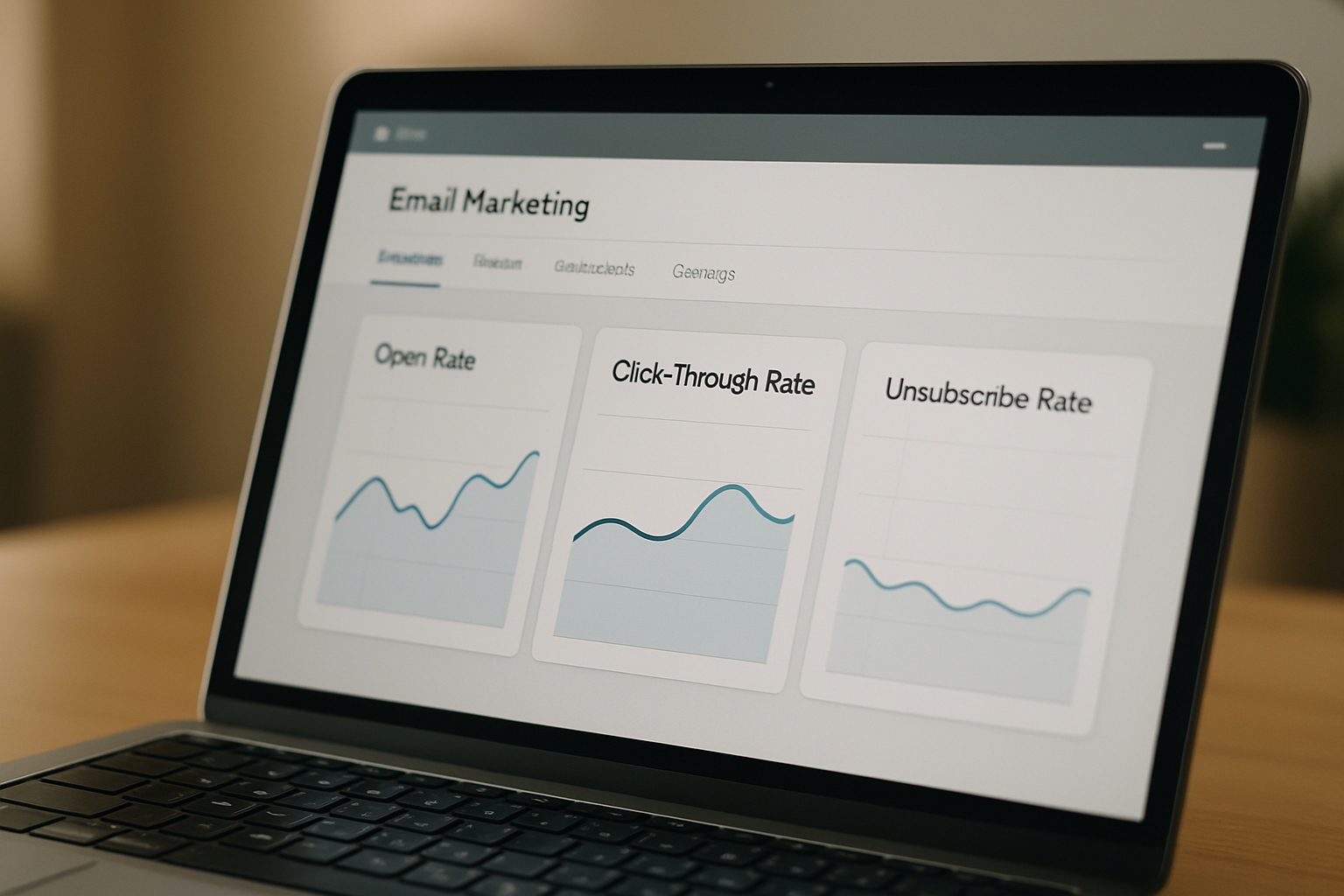
Treat open rate as directional. Judge yourself on click-through rate, click-to-open rate, conversion rate and unsubscribe rate. A good average email click-through rate typically ranges from about 0.77% to 4.36%, with the average across industries around 2.62%. Keep unsubscribes low. A healthy unsubscribe rate is generally below 0.2%.
| Metric | Realistic EU target | Why it matters |
|---|---|---|
| Open rate | ~22% and up (directional) | Distorted by Apple MPP, use as a trend not a verdict |
| Click-through rate | ~2% to 4% | The truest sign your content resonates |
| Conversion rate | Track against your own baseline | The metric that pays the bills |
| Unsubscribe rate | Under 0.5%, ideally below 0.2% | Earliest warning of inbox fatigue |
| Deliverability | Over 95% | Nothing else matters if you land in spam |
A/B testing methodology: what to test and in what order
Test one variable at a time and start with the highest-leverage element: the subject line, because it gates everything downstream. Then preview text, then the call to action, then send time. Test subject lines, preview text, offer types, CTA wording, button placement, imagery, email length and even send time. Give each test enough volume to mean something. At small Irish list sizes, do not declare a winner off forty clicks.
CTA design and placement
One primary action per email. Make it a button, not a buried link, and place it where it does not require a hunt. Make your primary call-to-action visually stand out using a button rather than hyperlinked text, place it high enough that readers do not have to hunt for it, and use benefit-driven language.
Your Email Health Score
Answer eight quick questions built for Irish and EU businesses. No email required. Your score and tier appear instantly.
Step 6: Connect Email to Your Other Digital Channels
This is the step every SaaS platform and generic listicle skips, and it is where Irish businesses win. Email is not a silo. It is the connective tissue of a full-funnel, multi-channel digital marketing strategy, and it works hardest when it feeds your social media marketing Ireland activity and your paid search rather than running beside them.
Email + social media: custom audiences, retargeting, and the feedback loop
Your consented email list is one of the most powerful assets you can hand to a paid social campaign. Upload it as a custom audience to build lookalikes of your best customers, or to exclude existing subscribers from acquisition spend so you stop paying to reach people you already own. This is exactly how we integrate email with social media for Irish clients, and the feedback loop runs both ways: social grows the list, the list sharpens the targeting.
From the agency floor
Home-services clients teach the same lesson email does: the highest-intent contact often comes by phone, not a form. Capture and count both, or you under-credit the whole funnel.
From the agency floor
Syncing a consented email list as an exclusion audience routinely lowers wasted acquisition spend, because you stop paying to advertise to people already on your list.
From the agency floor
Lookalikes built from engaged subscribers, not all subscribers, consistently outperform. Quality of the seed list drives quality of the audience.
Email + paid search: using your list to lower cost-per-acquisition
Customer match lets you layer your email list onto Google Ads to bid smarter on people who already know you and to seed lookalike-style expansion. Across our managed local-services search accounts, click-through rates have run roughly 4.2% to 7.6%, and the accounts that feed first-party audiences into targeting tend to hold cost per lead down as the data compounds. Email is often the cheapest first-party data you own. If you want the wider picture, our roundup of must-know marketing trends for Irish businesses puts channel integration in context, and our guide to paid social advertising Ireland covers the audience mechanics in more detail.
Email as connective tissue in a full-funnel strategy
Think of email as the layer that catches, nurtures and reactivates across everything else. Social and search create demand, email captures and converts it, and re-engagement recycles it. That is multi-channel digital marketing done properly, and it is the reason a Greystones agency perspective beats a platform’s single-tool pitch.
The businesses that win in 2026 are not the ones with the flashiest email. They are the ones whose email, social and search actually talk to each other.
AI-Assisted Email Marketing in 2026: Useful Tool, Real Risks
AI-generated email content is now everywhere, and it is genuinely useful. It is also quietly damaging a lot of brand voices. The data is encouraging on performance. HubSpot data shows 72% of marketers report AI-assisted content leads to higher performance. But higher performance and stronger brand are not the same thing.
What AI does well (and where it quietly damages brand voice)
Use AI for the heavy lifting: first drafts, subject-line variations to test, segment ideas, summarising analytics. Do not let it write in your voice unsupervised. The failure pattern we see is a brand that sounded like a person now sounding like every other AI-drafted newsletter in the inbox, and audiences notice. Keep a human editing every send, feed the model real examples of your tone, and treat AI as a junior copywriter you always review. For a broader take, see our piece on AI and personalisation in digital marketing.
Great for drafts and variations
Great for segment ideas
Risky for unsupervised voice
Choosing an Email Platform as an Irish Business: What Actually Matters
Every platform will tell you it is the best. What matters for an Irish business is GDPR readiness, EU data handling, honest pricing at your list size and whether it does the automation you actually need. Here is a straight comparison.
| Platform | Entry price tier | GDPR-ready | Best for |
|---|---|---|---|
| MailerLite | Low, generous free tier | Yes, EU-friendly | Small Irish SMEs and newsletters on a budget |
| Mailchimp | Mid, rises with list size | Yes | Beginners wanting an all-in-one |
| ActiveCampaign | Mid to high | Yes | Serious automation and CRM needs |
| Klaviyo | Higher, scales with contacts | Yes | Ecommerce with deep store integration |
| EmailOctopus | Low | Yes | Simple, affordable sending |
Want your email working as hard as your ads and social?
We are an independent digital marketing agency in Greystones, Co. Wicklow, and we connect email, social and paid search into one full-funnel strategy for Irish businesses.
Frequently Asked Questions
What are the most important email marketing best practices for Irish businesses in 2026?
Get consent right, authenticate your domain with SPF, DKIM and DMARC, segment your list, automate your welcome and re-engagement flows, and judge success on clicks and conversions rather than open rate. Consent and deliverability come first, because everything else depends on them.
How do GDPR rules affect email marketing strategy for EU-based companies?
They make consent the foundation. The general rule is that electronic direct marketing requires the clear, affirmative consent of the recipient, such as by specifically opting in, under Regulation 13 of the ePrivacy Regulations. There is a narrow soft opt-in for existing customers, and recipients can object at any time. In practice this produces smaller but far more engaged lists.
What email marketing metrics should Irish SMEs actually benchmark against?
Click-through rate, click-to-open rate, conversion rate and unsubscribe rate. Treat open rate as directional only, since Apple Mail Privacy Protection inflates it. A healthy unsubscribe rate is generally below 0.2%. Benchmark against EU figures, not US ones.
How does email marketing integrate with social media marketing for better results?
Upload your consented email list as a custom audience to build lookalikes of your best customers and to exclude existing subscribers from acquisition spend. Social grows the list, the list sharpens your targeting, and both channels get more efficient. This is core to multi-channel digital marketing.
What is the difference between B2B and B2C email marketing best practices?
Legally, B2C in Ireland requires prior opt-in consent, while B2B direct marketing emails can generally be sent unless the recipient has said it does not consent, provided the sender is not disguised and an opt-out is offered. Tactically, B2C tends to reward higher frequency and richer design, while B2B rewards less frequent, higher-value, often plainer content.
How often should you send marketing emails to your list in 2026?
It depends on your audience and sector. Ecommerce succeeds with higher frequency due to purchase intent, while B2B performs better with less frequent, higher-value content. Set expectations at signup, watch your unsubscribe rate, and let your own data decide rather than a generic rule.
What is a good email open rate in 2026 and how do you improve it?
For EU lists, an open rate above roughly 22% is a reasonable directional benchmark, though the number is distorted by Apple MPP. Improve it with a recognisable sender name, a value-led subject line, complementary preview text and a clean, engaged list. But prioritise clicks and conversions as your real measure of success.
How do you build an email list from scratch without buying contacts?
Offer a genuine reason to subscribe, such as a useful lead magnet or exclusive content, capture consent clearly with double opt-in, and let people choose topics and frequency. Grow it through your website, social channels and point of sale. Never buy a list, it damages deliverability and breaches GDPR.
What email marketing platform is best for small Irish businesses?
For most small Irish SMEs, MailerLite or EmailOctopus offer strong value and GDPR-friendly handling, while ActiveCampaign suits heavier automation and Klaviyo suits ecommerce. The best platform is the one set up correctly. In our audits the tool is rarely the problem, the configuration is.
How can AI tools improve email marketing without damaging brand voice?
Use AI for drafts, subject-line variations, segment ideas and analytics summaries, but keep a human editing every send. 72% of marketers report AI-assisted content leads to higher performance. Feed the model real examples of your tone and never publish unsupervised, or your brand starts sounding like everyone else’s.