
Yes, another article telling you to add FAQs to your product pages. This one actually tells you how to write them so they rank, get cited, and nudge a hesitant shopper over the line.
Here is the uncomfortable truth most SEO advice skips. The reason most product page FAQ sections do nothing is not technical. It is editorial. Somebody guessed five questions in twenty minutes, pasted bland answers, and called it done. No schema, no research, no objection handling. Those FAQs do not rank, do not convert, and can actually drag down the quality signals of an otherwise decent page. This guide treats FAQ integration as what it really is: a content discipline with its own research process, tone brief, and quality bar.
- Research first, write second. Pull real questions from support tickets, reviews, and search query reports, not your imagination.
- Prioritise the 20% of pages that drive 80% of revenue. You do not need FAQs on every SKU on day one.
- Write a direct answer in the first sentence. That is what wins featured snippets and gets cited by AI search.
- Add FAQPage JSON-LD so Google can render rich results. We give you a copy-paste example below.
- For Irish and EU stores, answer the questions shoppers actually ask: 14-day returns, VAT, and An Post delivery timing.
Best for: Irish and UK ecommerce teams, in-house content leads, and marketing managers who own product page copy. Not ideal if: you are looking purely for a developer schema tutorial with no writing guidance. Good first step if: your product pages are thin and you keep answering the same questions in support tickets. Call a pro if: you have hundreds of SKUs and no system for turning customer questions into ranking content.
Why Most Product Page FAQs Fail (And What to Do Instead)
When we audit Irish ecommerce stores, the same pattern keeps showing up. A product page has an FAQ block, but the questions were invented by someone who never read a single support ticket, the answers repeat the marketing blurb above, and there is no structured data telling Google any of it exists. Three failures stack on top of each other.
- The questions are wrong. They answer what the brand wants to say, not what the buyer is anxious about.
- The answers do not earn rich results. No direct answer sentence, no schema, so no eligibility for featured snippets or People Also Ask placements.
- They dilute the page. Generic, padded copy adds word count without adding value, and that is exactly what Google’s editorial guidance penalises.
Done properly, an FAQ section is one of the highest-leverage pieces of content on a product page, and a core part of any well-rounded SEO strategy for Irish ecommerce. It captures long-tail keywords that the product title and description never could, it handles purchase objections at the exact moment of hesitation, and it gives search engines clean question and answer pairs to lift into rich results. The fix is not a plugin. It is a process.
An FAQ block is the only place on a product page where you get to answer the question that is actually stopping someone buying. Waste it on “What is your brand mission?” and you have thrown away your best conversion real estate.
Step 1 – Research Questions From Real Customer Data (Not Guesswork)
Every good FAQ section starts with listening, not writing. The single biggest difference between an FAQ that ranks and one that gathers dust is whether the questions came from real buyer intent or from a brainstorm. Here are the three sources we mine for clients, in order of value.
Support Tickets and Live Chat Logs
Your support inbox is a transcript of every objection, doubt, and confusion that stands between a visitor and a purchase. Export six months of tickets and tag them by theme. The questions that appear ten times are the questions that belong on the product page. They are also, almost always, the long-tail keywords people type into Google before they buy. One of our practitioner principles applies here directly: the patterns repeat, so build a system rather than answering the same thing ad hoc.
Reviews, Q&A Sections, and Sales Call Transcripts
Reviews are gold for FAQ research because customers write them in the exact language they search with. Scan your own reviews, your competitors’ reviews, and any on-site Q&A widget. Sales call notes are the same idea for higher-consideration products. If five callers asked whether a mattress suits side sleepers, that is a featured-snippet opportunity wearing a disguise.
Search Query Reports and PAA Mining
Open Google Search Console, filter the queries hitting each product or category page, and look for question-shaped searches and modifiers like “how”, “can I”, “does it”, and “vs”. Then run the product name through Google and read the People Also Ask box. Those PAA questions are a literal list of what the search engine already associates with your topic. Mining them is one of the most reliable strategies for creating FAQ content that matches demand instead of guessing at it. If you want a deeper system for sourcing and structuring these, our blueprint for creating high-converting FAQ sections walks through the full workflow.
Step 2 – Prioritise Which Product Pages Get FAQs First
You do not have the time to write a researched FAQ block for 800 SKUs, and you should not try. Apply the 80/20 rule: a small share of your product pages drives most of your revenue and most of your organic traffic. Those pages get FAQs first. Everything else waits.
Score each page on two axes: traffic potential and conversion value. The matrix below tells you where to start.
| Product page type | Traffic tier | Conversion value | FAQ urgency |
|---|---|---|---|
| Hero / bestseller product | High | High | Urgent |
| High-margin or high-AOV product | Medium | High | Valuable |
| Top category / collection page | High | Medium | Optional but worth it |
| Long-tail niche product | Low | Medium | Later |
| Discontinued / clearance line | Low | Low | Skip |
For one ecommerce client we rewrote the FAQ sections on their top ten product pages using support-ticket-sourced questions rather than guesses. The work paid for itself two ways: the pages started surfacing for additional long-tail and question queries, and the support team stopped fielding the same pre-purchase questions because the answers were now on the page. Concentrating effort on the highest-value pages is what made it efficient, not spreading thin across the whole catalogue.
Step 3 – Write FAQ Answers That Earn Rich Results AND Convert
This is where most teams lose. They have good questions and then write answers that read like a legal disclaimer. An FAQ answer has two jobs at once: satisfy a search engine looking for a concise, liftable answer, and reassure a human who is deciding whether to spend money. You write for both in the same sentence.
Answer Length and Reading Level
Lead with the answer. The first sentence should answer the question directly and completely, in plain language, before you add any nuance. That single structural choice is what makes copy eligible for featured snippets and is the foundation of faq sections for featured snippets seo. Keep the full answer to roughly 40 to 60 words for snippet-friendly questions, expand to a short paragraph only when the buyer genuinely needs more. Aim for a reading level a busy shopper on a phone can scan in two seconds.
Matching FAQ Copy to Brand Voice
An FAQ that sounds like it was bolted on by a different person erodes trust. Write a one-line tone brief for the section (“warm, direct, no jargon, speaks like the founder would on a call”) and hold every answer to it. The best landing page faq conversion best practices are not tricks, they are simply answers that sound like a helpful human removing a specific doubt. Name the objection, resolve it, and where it helps, add the reassuring detail that tips the decision.
Irish and EU-Specific FAQ Content That Shoppers Actually Need
This is where generic advice falls down and where Irish and EU stores win. Your shoppers have specific, repeatable concerns that a US template will never cover. Answer them on the page.
Returns window
Under EU consumer law, distance buyers generally have a 14-day cooling-off period to cancel (Directive 2011/83/EU). Say it plainly, it removes a real objection.
VAT clarity
State whether prices include Irish VAT and how it applies, especially for digital goods and cross-border orders. Ambiguity kills carts.
Delivery timing
Give An Post and courier delivery windows for the island of Ireland, plus any cut-off times. “Will it arrive before the weekend?” is a top buyer question.
These questions are not filler. They are the exact objections that stall a checkout, and they double as long-tail keywords. Writing them well is the same skill as the rest of your content writing services: research, clarity, and a point of view.

Step 4 – Implement FAQPage Schema (With a JSON-LD Example)
Now the technical layer. FAQPage structured data is the markup that tells Google your question and answer pairs exist so it can render them as rich results. Without it, you have good content that search engines have to infer. With it, you are eligible for expanded SERP listings and you give AI systems clean, labelled answers to draw from.
Here is a real, copy-paste FAQPage JSON-LD example for a running shoe product page. Drop it in the page head or body, swap in your own questions and answers, and validate it. Zero competitors give you this, so here it is in full.
<script type="application/ld+json">
{
  "@context": "https://schema.org",
  "@type": "FAQPage",
  "mainEntity": [                          // each Q&A pair is one entry
    {
      "@type": "Question",
      "name": "Do the Trailblaze 7 runners come up small?",
      "acceptedAnswer": {
        "@type": "Answer",
        "text": "They fit true to size for most runners. If you wear thick socks or have a wide foot, order a half size up. Our returns are free within Ireland, so it is easy to swap."
      }
    },
    {
      "@type": "Question",
      "name": "Can I return these shoes if they do not fit?",
      "acceptedAnswer": {
        "@type": "Answer",
        "text": "Yes. You have 14 days from delivery to return unworn shoes for a full refund under EU consumer law, and we cover return postage within Ireland."
      }
    },
    {
      "@type": "Question",
      "name": "How long does An Post delivery take?",
      "acceptedAnswer": {
        "@type": "Answer",
        "text": "Standard An Post delivery is 2 to 3 working days across the island of Ireland. Order before 1pm on a weekday for same-day dispatch."
      }
    }
  ]
}
</script>
Three rules keep this valid. The text inside each acceptedAnswer must match the answer a visitor actually sees on the page. Only mark up genuine question and answer pairs, not navigation links or promotional copy. And after you publish, run the URL through Google’s Rich Results Test to confirm Google can read the FAQPage markup. Google’s own FAQPage structured data documentation is the authoritative reference for the required and recommended properties.
Step 5 – Position FAQs on the Page for Maximum Impact
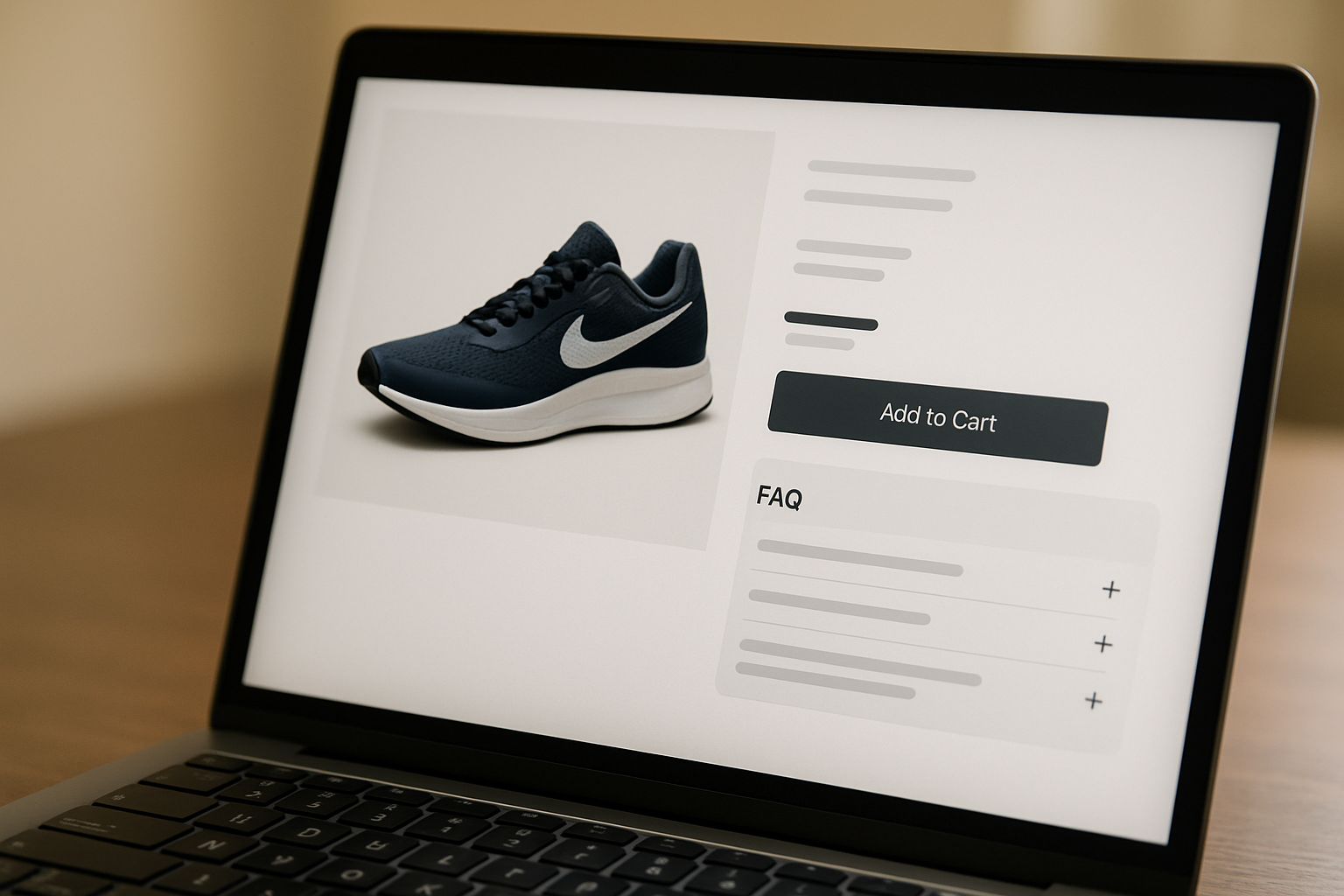
Placement decides whether your FAQ does its job. Put it where doubt peaks, which is usually just below the buy button and pricing, after the visitor has seen the product but before they bounce to compare. On a long product page, a second compact FAQ near the bottom catches the deep scrollers.
Now the nuance no competitor mentions. If you build your FAQ as a collapsible accordion, use native HTML details and summary elements or a progressive-disclosure pattern that keeps the answer text in the page’s HTML. Do not hide answers with CSS display:none in a way that strips them from the rendered DOM, because content a crawler cannot see is content it will not rank or mark up. The accordion at the bottom of this very article is built with details and summary for exactly that reason: it toggles for users while staying fully crawlable.
| Approach | Schema eligibility | Best use case | Content volume needed |
|---|---|---|---|
| Inline product-page FAQ | FAQPage on the product URL | Objection handling at point of purchase | 3 to 6 tight Q&A pairs per product |
| Standalone FAQ page | FAQPage on a dedicated URL | Brand, shipping, and policy questions shared across the store | 15 to 40 broad Q&A pairs |
| Category-level FAQ | FAQPage on the category page | Questions common to a whole product range | 4 to 8 range-wide Q&A pairs |
Inline FAQs do the heavy lifting for conversion and long-tail capture. A standalone FAQ page is still useful for store-wide policy questions, but it will not move a specific product’s rankings the way page-level FAQs do. Strong internal linking between them helps Google understand the relationship and spreads authority across your ecommerce content strategy.
Industry data suggests the page in the featured snippet position captures roughly a fifth of organic clicks for that query, which is the prize a well-structured FAQ answer competes for.
Aggregated from published click-through-rate studies on position-zero results
How FAQ Content Feeds AI Search (SGE, Bing Copilot, ChatGPT)
AI Overviews, Bing Copilot, and ChatGPT-style answers are increasingly the layer between your product and the buyer. They pull from clearly structured, directly answered content, and a well-built FAQ block is close to the ideal raw material. Three structural signals make a FAQ answer more likely to be cited.
Direct answer in sentence one
Named entity, not “it” or “this”
Qualifying context after the answer
Notice these are the same habits that win featured snippets. An AI system extracting an answer wants the same thing a snippet algorithm wants: a self-contained, unambiguous response it can lift without misrepresenting you. The FAQ content most likely to be picked up shares a clear pattern: it states the answer plainly, names the product or policy explicitly rather than relying on pronouns, and adds one line of context that resolves the buyer’s real concern. Voice search behaves the same way, since voice assistants read back a single concise answer to a conversational query. If you are choosing tools to support this work, our take on AI keyword research tools for Irish SEO covers what is worth keeping.
You do not write differently for AI search, featured snippets, and voice. You write one clear, direct, entity-named answer, and all three reward it. That is the whole trick, and it is a writing skill, not a markup hack.
The Editorial Quality Bar – What Google Expects From FAQ Copy
Here is the part the schema tutorials skip. Markup makes your FAQ eligible for rich results, but editorial quality decides whether you actually earn them and keep them. Google’s quality guidance rewards content that is helpful, original, and clearly created to serve people rather than to game search. A padded FAQ stuffed with keyword variations does the opposite.
Hold every answer to three standards. Is it accurate and specific to this product, not a generic template? Does it genuinely help someone decide? Would you be comfortable if a customer read it back to you on the phone? Copy that passes all three improves dwell time and lowers bounce rate because visitors get their answer and stay to buy, instead of leaving to find it elsewhere. That engagement signal compounds over time. This is the standard our content writing agency in Ireland applies to every page, and it is the difference between SEO content writing that ranks and copy that just fills space.
Schema gets you to the door. Editorial quality is what gets you through it and keeps you in the room.
FAQ Integration Checklist for Product Pages
Before you publish a product-page FAQ
- Questions sourced from real data: support tickets, reviews, sales calls, Search Console, and People Also Ask, not guesswork.
- Page prioritised: you are working the high-traffic, high-value pages first, not the whole catalogue.
- Direct answer first: every answer leads with a complete reply in the opening sentence.
- Brand voice held: answers sound like a helpful human, matched to a one-line tone brief.
- Irish and EU specifics covered: 14-day returns, VAT clarity, An Post delivery timing.
- FAQPage JSON-LD added: markup matches the visible on-page text exactly.
- Validated: the URL passes Google’s Rich Results Test for FAQPage.
- Crawler-safe accordion: answers live in the DOM, never hidden with display:none.
- Positioned for impact: placed near the buy button where doubt peaks.
- Quality bar met: accurate, specific, genuinely helpful, no padding.
Want your product page FAQs to actually rank?
We research the real questions, write the answers in your voice, and add valid FAQPage schema. Built for Irish ecommerce stores.
For the wider content engine behind this, see our SEO content writing services. And if your product and landing pages are losing buyers for other reasons, these guides help: critical landing page mistakes to avoid and how website speed boosts conversions and SEO.
FAQs About FAQ SEO
Are FAQ pages good for SEO?
Yes, when they are researched and structured properly. A good FAQ section captures long-tail and question-based searches, makes you eligible for featured snippets and People Also Ask placements through FAQPage structured data, and answers buyer objections at the point of purchase, which improves dwell time and reduces bounce rate.
The caveat is that a generic, guessed-at FAQ with no schema and padded answers can do nothing or even dilute page quality. The value comes from real questions, direct answers, and clean markup, not from the FAQ block existing.
How do you add FAQ schema to a WooCommerce product page?
You add FAQPage JSON-LD to the product page so Google can read your question and answer pairs. Three common routes: use a WooCommerce or WordPress SEO plugin that includes an FAQ block with automatic schema, add the FAQ via the block editor with a structured-data-aware FAQ block, or paste a hand-written FAQPage JSON-LD script into the page using a code block or a header-and-footer plugin.
Whichever route you take, make sure the markup matches the visible FAQ text exactly and validate the page with Google’s Rich Results Test before you call it done.
What is the 80/20 rule for SEO?
The 80/20 rule for SEO means roughly 80% of your results come from about 20% of your pages and effort. Applied to product page FAQs, it tells you to focus your FAQ writing on the small set of pages that drive most of your revenue and organic traffic first, rather than spreading thin across the whole catalogue.
Score pages by traffic potential and conversion value, work the top-right quadrant, and you get most of the upside for a fraction of the effort.
How do you write FAQs for SEO?
Start by sourcing real questions from support tickets, reviews, sales calls, Search Console queries, and People Also Ask. Then write each answer with the direct reply in the first sentence, keep snippet-friendly answers to about 40 to 60 words, name the product or policy explicitly instead of using pronouns, and match your brand voice.
Finally, mark the pairs up with FAQPage JSON-LD, place the FAQ where buyer doubt peaks, and hold every answer to a genuine editorial quality bar so it helps a real person decide.