
Picture a Dublin plumber on a Tuesday. Between callouts, driving, and jobs where both hands are already busy, that phone rings a dozen times and gets answered maybe four. Say eight calls slip to voicemail across the day, and the average job is worth around 350 euro. That is potentially 2,800 euro of work walking to a competitor before dinner. Multiply it across a week and the number stops being an inconvenience and starts being a payroll.
This is the exact problem a missed call text back service solves, and it is one of the few fixes in marketing where the data is genuinely one-sided, and it sits at the heart of CRM and lead generation for trades. Below is a full set of missed call text back service conversion rate statistics, segmented by industry, framed in euro, and written for the Irish and wider EU market, including the GDPR angle almost every other guide ignores. The short version: when a call goes unanswered, an instant automated text back is the highest-leverage way to turn missed calls into revenue, and the research explains precisely why missed call text back increases conversions.
What Is a Missed Call Text Back Service? (How It Works in 60 Seconds)
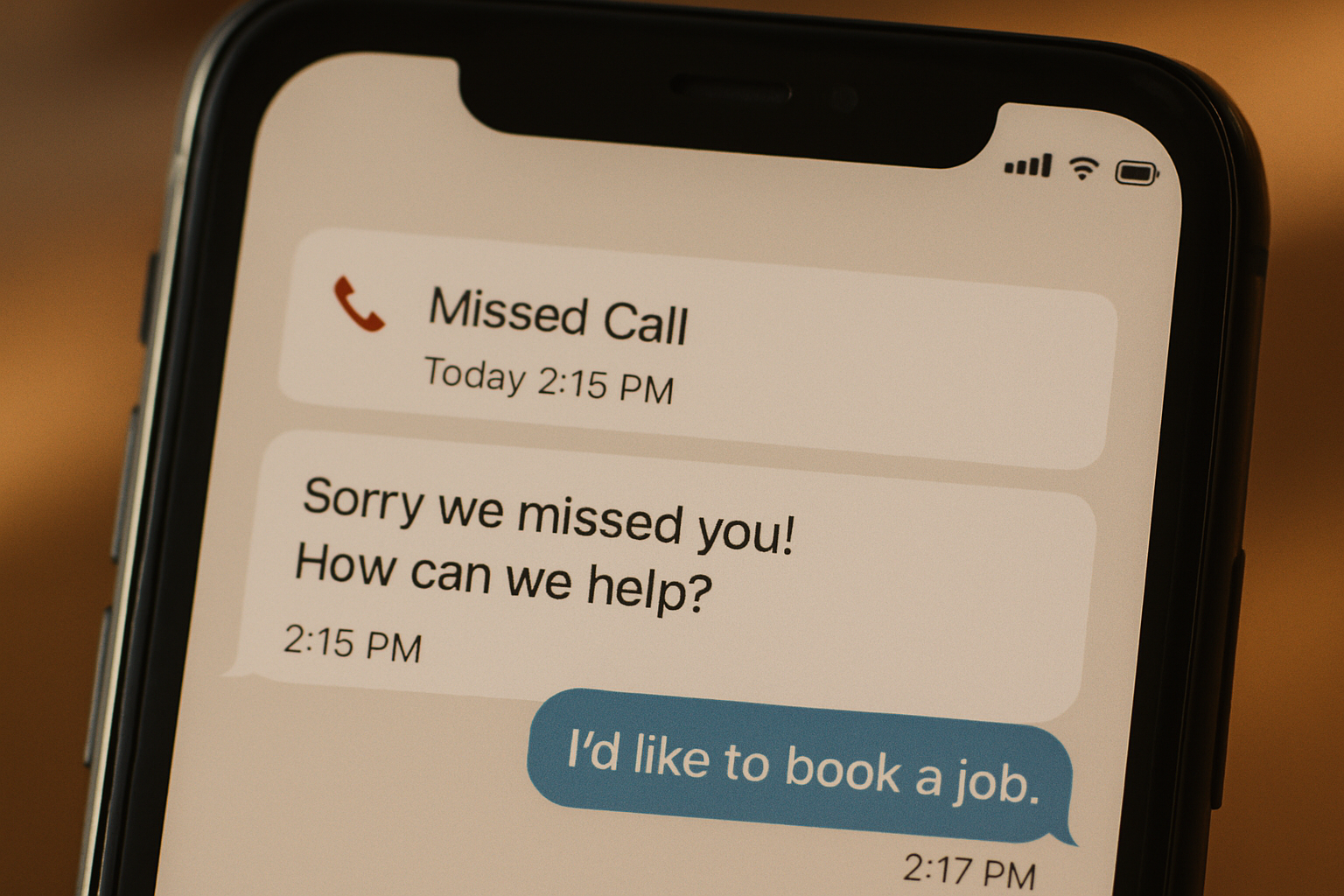
A missed call text back service is an automated system that detects when an inbound call goes unanswered and instantly fires a text message to that caller, usually within seconds. Instead of the caller hitting voicemail, hanging up, and dialling the next business on Google, they get a friendly text: “Sorry we missed you, this is [Business]. How can we help?” The conversation then continues by SMS, a channel people actually reply to.
The mechanics are simple and run without anyone lifting a finger. Here is the automated text back workflow start to finish.
The whole point is speed and channel. The caller never experiences a dead end, and you never lose the enquiry to the silence of a voicemail box nobody checks until 6pm.
The Scale of the Problem: How Many Business Calls Go Unanswered?
Before the conversion numbers make sense, you need the size of the leak. It is much bigger than most owners think. The most-cited missed call statistics come from a study by 411 Locals. In their study, 411 Locals monitored 85 businesses across 58 industries for 30 days and found that while 37.8% of calls got answered, another 37.8% went to voicemail and 24.3% got no response at all. That is roughly six in ten calls unattended.
of calls to small businesses go unanswered, with only 37.8% reaching a live person
411 Locals study of 85 businesses across 58 industries
This is not a niche finding. A staggering 70% of businesses answered less than half of their calls. When you widen the lens across multiple datasets, small and mid-sized service businesses appear to miss between roughly 25% and 60% of inbound calls, with the lower end reflecting structured environments with dedicated front-desk staffing and the upper end reflecting field-based businesses, understaffed intake, or peak-demand congestion. For Irish trades and clinics that are often owner-operated, you are firmly in the upper band.
The average Irish SME is not losing calls occasionally, it is losing the majority of them structurally. If you have never counted, assume your answer rate is worse than you would guess, especially for after-hours enquiries. That gap is the single most fixable revenue problem on your desk.
Missed Call Statistics by Industry (Trades, Healthcare, Legal, Home Services)
Miss rates vary by sector, and so does the cost of each miss. Home services and trades sit at the sharp end because the work is field-based and often urgent. According to Invoca’s research, home service businesses miss around 27% of their inbound calls, with each missed call costing approximately 1,200 dollars in lost revenue. Other analyses put the home-services miss rate far higher during busy periods. Healthcare has a distinct after-hours problem: in healthcare settings, studies show about 67% of after-hours patient calls go unanswered, causing delays in care and administrative headaches.
The reason phone leads matter so much is that they convert. Phone calls are the highest-intent lead channel available, and according to BIA/Kelsey research, phone calls convert at 10 to 15 times the rate of web form leads, so a missed call is not just a missed conversation, it is a missed sale from someone who was ready to buy. This matches what we see in our own accounts.
What Happens to a Caller You Don’t Answer? (The Behaviour Data)
People do not wait patiently. The behaviour after an unanswered call is fast and unforgiving, which is exactly why unanswered calls are harming business ROI far more than the raw miss rate suggests.
An unanswered call is rarely read as “they must be busy.” It is read as “they are unavailable,” and the caller acts on that in seconds.
The two numbers that should worry any owner: 85% of callers who reach voicemail never call back and 62% contact a competitor instead. On top of that, approximately 80% of callers who reach voicemail hang up without leaving a message. The expectation is real-time. Industry research indicates that 77% of customers expect an immediate response when calling a business, so speed is not a competitive advantage, it is an assumed baseline.
Voicemail, in other words, is a dead channel. The caller who hangs up is already dialling the next name on the Google results page. A missed call text back service intercepts that person in the few seconds where they are still deciding, which is the whole game.
Missed Call Text Back Conversion Rate Statistics: What the Research Shows
Here is where the missed call text back conversion rate becomes the headline. The advantage rests on one structural fact: SMS gets seen and answered in a way no other channel manages. SMS has a response rate of 45% compared to email’s 6%, and 98% of text messages are opened and read, in sharp contrast to the average email open rate of around 37%.
SMS response rate, versus roughly 6% for email, which is why a text back re-opens conversations voicemail kills
Notifyre / industry SMS benchmarks, 2025
Speed makes it work. Around 32% of recipients open a text within 60 seconds, by five minutes that number climbs to 81 to 82%, and within three minutes roughly 90% of SMS messages have been read. That immediacy is the difference between recovering the lead while intent is still hot and finding a stale voicemail hours later. It is also why 90% of people prefer texting with businesses over a phone call.
SMS vs. Email vs. Voicemail vs. Callback: Channel Comparison
No competitor in this space lays the channels side by side. Here is the comparison that actually answers the question, with the EU compliance note included.
| Metric | SMS text back | Email follow-up | Voicemail | Live callback attempt |
|---|---|---|---|---|
| Open / read rate | ~98% | ~20 to 37% | ~80% ignore it | N/A (many go unanswered) |
| Response rate | ~45% | ~6% | Very low (most never call back) | Low if caller already moved on |
| Typical time to be seen | Minutes | Hours to days | Whenever inbox is checked | Depends on staff availability |
| Caller preference | High (~90% prefer texting) | Moderate | Low | Mixed |
| Automatable instantly | Yes | Yes | Passive only | No, needs a person |
| Irish GDPR note | Reply to their own call is a service reply, not cold marketing | Same principle applies | No consent issue | No consent issue |
Read down the “response rate” row and the case makes itself. The caller reached out first, and a text is the one channel that reliably re-connects with them.
How Conversion Rates Degrade with Response Delay (Speed-to-Lead Breakdown)
Speed-to-lead is the mechanism behind every one of these numbers. The canonical research comes from Dr James Oldroyd at MIT. That study drew on three years of data across six companies, 15,000-plus leads and 100,000-plus call attempts, plus a separate survey covering 495 responses across 40-plus industries. The finding is blunt: the odds of contacting a lead if called in 5 minutes versus 30 minutes drop 100 times, and the odds of qualifying a lead if called in 5 minutes versus 30 minutes drop 21 times.
Harvard Business Review’s own audit added the supporting picture. The most-cited benchmark is a 42-hour average response time, from HBR’s 2011 audit of 2,241 US companies, which also found that 23% of companies never responded at all and 24% took more than 24 hours. The speed-to-lead effect is why a missed call text back service that fires in seconds beats a callback you get around to that afternoon.
How Much Are Missed Calls Costing Your Business? (Revenue Calculator)
The aggregate figure quoted everywhere is that the average small business loses approximately 126,000 dollars per year to missed calls, according to estimates from AMBS Call Center. That number accounts for lifetime value and varies enormously by sector, so a headline figure is less useful than your own maths. Enter your real numbers below to see what unanswered calls are costing you, and what an SMS recovery rate would claw back.
Missed Call Revenue Calculator (EUR)
Irish SME defaults are pre-filled. Change them to your figures.
Illustrative estimates only, assuming one converted job per recovered caller. Actual results vary by industry, call volume and job value. Not a guarantee of outcome.
Run the Irish default and the picture is stark. Forty calls a week, 280 euro average value, 45% answer rate: that is 22 missed calls a week and a six-figure annual exposure. Even recovering a modest slice of those with automated SMS follow-up pays for the service many times over. This is genuinely how you turn missed calls into revenue rather than treating them as an unavoidable cost of being busy.
One of our Co. Wicklow home-services clients treated calls as their primary lead channel from day one. In a single month we logged 19 tracking-number calls, 18 of them genuine enquiries over 25 seconds, sitting alongside their web-form leads. When calls are that central, every one you fail to capture is a job you funded through advertising and then handed to a competitor.
Missed Call Text Back Conversion Rates by Industry Vertical
No two sectors leak at the same rate or the same value, so here is a vertical breakdown with EUR job values and a realistic expected SMS recovery band. Figures are directional, blended from the studies above and framed for the Irish market.
| Industry | Typical missed call rate | Avg job value (EUR) | Annual revenue at risk | Expected SMS recovery |
|---|---|---|---|---|
| Trades (plumbing, electrical) | High (40 to 62%) | 250 to 600 | Five to six figures | 15 to 25% |
| Home services (cleaning, landscaping) | Moderate to high (27%+) | 150 to 500 | Five figures | 15 to 25% |
| Healthcare / clinics / dental | High after-hours (~67%) | 80 to 400 per visit | Five to six figures | 10 to 20% |
| Legal services | Moderate | Very high per case | Six figures per lost case | 10 to 20% |
| Professional services / accountancy | Moderate | Recurring, high LTV | Five to six figures | 10 to 20% |
Trades and Home Services
The highest-value fix. These callers are usually mid-emergency (a burst pipe, a dead boiler) and will call the next name instantly. The miss rate climbs higher during peak seasons or busy hours because owners and crews are in the field and not near a phone. An automated text back that says “we got your call, what is the issue and where are you?” holds that caller while you are still up a ladder.
Healthcare and Clinics
The after-hours gap is the killer here, with roughly two-thirds of out-of-hours patient calls going unanswered. A compliant text back that confirms receipt and offers a booking link recovers appointments that would otherwise become no-shows or losses to another practice.
Legal Services
Volume is lower but the value per enquiry is enormous. Law firms face steep losses because missing a call from someone who just got injured or arrested can mean losing a case worth tens of thousands in fees. A single recovered call can outweigh a year of the service cost.
Professional Services and SMEs
Accountants, consultants and agencies deal in recurring, high-lifetime-value clients. The immediate job value understates the loss, because one recovered enquiry can become a multi-year relationship. For every sector, the same logic applies: capture the caller before the silence sends them elsewhere.
The Psychology of SMS: Why Text Converts Better Than a Callback
Why does a text beat you personally ringing them back an hour later? Three reasons, and they are all behavioural.
It gets seen
It hits while intent is hot
It matches how people prefer to talk
First, visibility. A text lands in the same inbox as messages from family and friends, with no spam folder, no promotions tab and no algorithm deciding whether it deserves to be seen. Second, timing. Because the text fires in seconds, it reaches the caller inside the tiny window where they are still comparing options rather than after they have booked someone else. Third, preference. About 77% of SMS messages receive a response within ten minutes, more than three times faster than email. People will tap out a reply to a text they would never leave on a voicemail.
A callback also fails at the exact moment it needs to succeed: 80% of people don’t pick up the phone for numbers they don’t know. So even your callback risks becoming the missed call. A text sidesteps that entirely.
Missed Call Text Back Conversion Rate Statistics and Irish Law: GDPR and EU Compliance Explained
This is the section every US-focused guide skips, and it is the one Irish business owners actually worry about. The good news: replying by text to someone who just rang you is not the same as cold marketing.
Ireland’s rules on electronic marketing sit under the ePrivacy Regulations, enforced by the Data Protection Commission. In Ireland, direct marketing emails, which includes SMS and other text, voice, sound or image messages, can generally only be sent to users with their prior opt-in consent. But a missed call text back is not unsolicited marketing. The caller initiated contact by ringing you. Unsolicited communication is essentially something that was not sought or requested, and if you have an ongoing or recent relationship with a person, then contact from that person might not be deemed unsolicited, as some form of consent may be present. A service reply answering their own enquiry is a legitimate response, not a marketing push.
An automated reply that helps with the specific enquiry the caller just made is a service message, not a marketing message. The compliance risk only appears if you keep texting them promotions afterwards. Keep the text back transactional, offer a clear opt-out, and do not fold their number into a marketing list without proper consent.
Where you do want to market to them later, the line matters. The general rule is that electronic direct marketing requires clear, affirmative consent under Regulation 13 of the ePrivacy Regulations, with a limited exception only in cases involving existing customers where certain other conditions are met. That existing-customer exception, the “soft opt-in,” lets you market similar services to someone who bought from you, provided you gave them a clear chance to object and you contact them within 12 months. The penalties for getting it wrong are not trivial: on summary prosecution a maximum fine of 5,000 euro per message can be handed down, and on conviction on indictment a company may be fined up to 250,000 euro per message.
Practical rule of thumb for an Irish missed call text back service: the instant reply answering the caller’s own query is fine, always include an easy opt-out, and treat any later promotional texting as a separate activity that needs consent. For the full legal detail, the DPC publishes clear guidance on the rules for direct electronic marketing.
Realistic Lift Figures: What to Expect After Implementing Missed Call Text Back
Be sceptical of the wilder claims floating around this niche. Some pages quote “recovers 93% of missed leads,” which is optimistic marketing, not a defensible average. A grounded expectation is this: not every missed caller will convert, but a meaningful and consistent slice will, because you are catching people who reached out with real intent.
Set your baseline using the channel data. With SMS response rates around 45% and roughly a quarter of engaged, high-intent conversations turning into a booking, a 15 to 25% recovery rate on missed calls is a realistic planning figure for most Irish service businesses. That is the band used in the calculator and the industry table above, and it is deliberately conservative.
What a sensible rollout looks like
- Measure first: count your real answer rate for two weeks, including after-hours, before you assume anything.
- Set the trigger tight: the text back should fire within seconds, not minutes, to catch the speed-to-lead window.
- Write a service-first message: acknowledge the missed call, ask how you can help, keep it transactional and GDPR-clean.
- Route replies to a human fast: automation opens the conversation, a person closes the job.
- Track recovered revenue: tag which bookings started as missed calls so you can prove the ROI in euro.
If you want the wider strategy this sits inside, our Revenue Recovery Blueprint for converting every missed call and unanswered enquiry into profit maps the full system, and it works hand in hand with proper phone call tracking and attribution so you can see exactly where each recovered lead came from. If capturing enquiries from your website is also leaking, the most common landing page mistakes for local service businesses are worth fixing at the same time. All of this is part of building proper marketing automation for Irish SMEs.
Are missed calls quietly costing you jobs?
We set up automated SMS follow-up for Irish trades so every missed call gets a text back in seconds. Find out exactly what your call leak is costing you in euro.
Frequently Asked Questions
Is missed call text back legal in Ireland?
Yes, when used correctly. An automated text replying to a caller who just rang you is a service response to an enquiry they initiated, not unsolicited marketing, so it does not fall foul of the general opt-in rule for direct marketing under Ireland’s ePrivacy Regulations. The compliance line matters if you later send that number promotional messages, which does require consent. Keep the initial text transactional, include a clear opt-out, and do not add the caller to a marketing list without proper GDPR-compliant consent.
How much are missed calls costing my business?
It depends on your call volume, answer rate and average job value, which is why the calculator on this page uses your own figures. As a benchmark, the widely cited industry estimate is around 126,000 dollars per year for an average small business when lifetime value is included. Using the Irish default of 40 calls a week at 280 euro with a 45% answer rate produces a six-figure annual exposure, most of which is recoverable with an instant text back.
What is a missed call text back system and how does it work?
It is an automated system that detects an unanswered inbound call and instantly sends the caller a text message, usually within seconds. The caller replies by SMS, a channel with a roughly 45% response rate, and the conversation continues until it becomes a booking. It removes the dead end of voicemail, which around 80% of callers never bother to use, and it works around the clock with no extra staff.
How quickly should a text back be sent to maximise conversion?
As close to instant as possible, ideally within seconds and certainly under a minute. MIT and InsideSales research found the odds of contacting a lead drop around 100 times when you respond at 30 minutes versus 5 minutes. Because roughly 32% of texts are opened within 60 seconds and about 90% within three minutes, an automated system that fires immediately captures the caller while their intent is still hot.
What industries benefit most from missed call text back?
Phone-first, high-intent sectors gain the most: trades like plumbing and electrical, home services, healthcare clinics, legal firms and professional services. Trades and home services see the highest miss rates because staff are in the field, while healthcare has a severe after-hours gap with roughly two-thirds of out-of-hours patient calls unanswered. Legal services benefit despite lower volume because a single recovered enquiry can be worth thousands.
How does missed call text back compare to just calling the customer back?
A text usually wins. Around 80% of people do not answer calls from numbers they do not recognise, so your callback risks becoming another missed call. A text gets a roughly 98% open rate, arrives in seconds rather than whenever you get a spare moment, and matches how most people prefer to communicate, with about 90% saying they would rather text a business than call. The strongest approach is automation to open the conversation instantly, then a human to close the job.