
In January 2026, Digital Business Ireland published a finding that should stop every Irish business owner in their tracks: doubling the average level of digital investment by Irish SMEs could add billions to the national economy. The gap is not talent or ambition. It is that most owners genuinely do not know what the average ad spend for small businesses in Ireland in 2026 should be, so they either underspend into irrelevance or overspend into panic.
This guide fixes that. Below you will find Ireland-specific advertising budget benchmarks for 2026 by sector, a live calculator, realistic per-euro return expectations, a VAT explainer built for Irish Meta and Google advertisers, and a month-by-month ramp-up model drawn from campaigns we actually run. So why do most Irish SMEs still have no idea what their ad spend should be? Let us answer that properly.
By the Sink or Swim Marketing team, paid media specialists based in Greystones, Co. Wicklow. We manage Google Ads and Meta campaigns for Irish and international small businesses and report on real spend, cost per lead and ROAS every month.
What Does the Average Irish SME Actually Spend on Advertising in 2026?
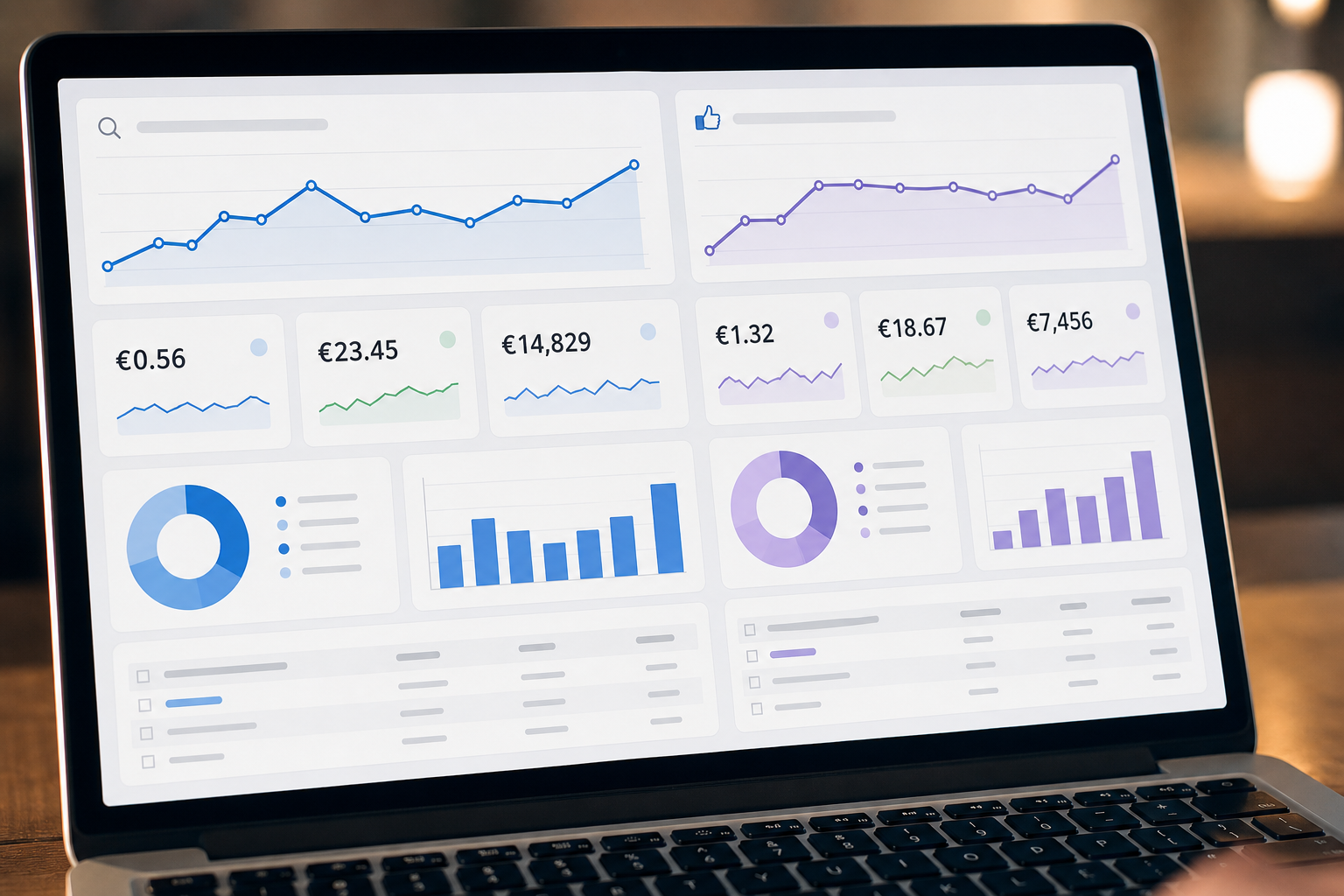
There is no single national figure, and anyone quoting one is guessing. What exists instead is a clear set of spending tiers that Irish small businesses fall into, and each tier buys a very different outcome. The honest way to talk about Irish SME ad spend is by tier, not by average, because a €300 budget and a €4,000 budget are not doing the same job.
The context matters. In 2024, 37.9% of small enterprises in Ireland were engaged in digital commerce, the second highest rate in Europe, yet many SMEs have still not reached the level of digital maturity required to compete effectively. Plenty of Irish firms are online. Far fewer are advertising with any structure behind it.
Micro-Budget (Under €500/month)
At under €500 a month, you are buying data, not results, and that is fine if you know it going in. This tier suits a single-location trades business or a shop testing whether paid search even makes sense for them. You will get clicks, a handful of leads, and a rough read on your cost per lead. What you will not get is stable, predictable volume.
Yes, €200 a month on Google Ads will teach you something. It will teach you that €200 a month on Google Ads is not enough to survive the learning period, let alone scale. Treat this tier as a paid experiment with a fixed end date, not a strategy.
Small Business (€500 to €2,000/month)
This is where most Irish SMEs genuinely live. A budget in this band, spent on one focused channel, is enough to clear the algorithm learning period and produce a repeatable flow of enquiries. For a local service business in Ireland, this is the realistic entry point for treating paid ads as a lead source rather than a gamble.
Growth-Stage (€2,000 to €5,000/month)
At this level you can run two channels properly, layer in remarketing, and give each campaign enough spend to exit learning quickly. This is the tier where a well-managed account starts compounding: negative-keyword work, audience refinement and geo-targeting all have enough volume to bite. B2B or considered-purchase businesses often need €2,000 to €5,000 per month, since B2B keywords tend to carry higher costs per click and longer decision cycles.
Do not ask what the average business spends. Ask which tier your goals require. Under €500 buys learning, €500 to €2,000 buys a working lead channel, and €2,000 to €5,000 buys compounding growth across more than one platform.
Try It: The Irish SME Ad Budget Calculator
Before the tables and benchmarks, put your own numbers in. This calculator uses Irish-market cost-per-click ranges by sector to give you an indicative monthly ad spend, a suggested channel split and a rough lead estimate. It runs entirely in your browser.
Irish SME Ad Budget Calculator
Your indicative benchmark
These are indicative benchmarks anchored to Irish-market data, not guarantees. Your real numbers depend on offer, competition and account management.
Irish SME Ad Spend Tiers: Spend, Mix and Realistic Output
Here is the same tier logic as a table you can self-identify against. Use it to sanity-check what the calculator gave you.
| Tier | Monthly Ad Spend | Recommended Channel Mix | Realistic Irish-Market Output |
|---|---|---|---|
| Pre-budget / testing | Under €300 | One channel, one campaign | Directional data only, not a lead source |
| Micro | €300 to €500 | Single channel (usually Google Search) | A handful of leads, rough cost per lead read |
| Small | €500 to €2,000 | One channel done well, then add remarketing | Repeatable enquiry flow once out of learning |
| Growth | €2,000 to €5,000 | 70/30 Google and Meta, plus remarketing | Compounding volume, two working channels |
| Scale | €5,000+ | Multi-channel, audience-led, always-on | Predictable pipeline, ROAS-driven expansion |
Percentage-of-Revenue Benchmarks: The 5 to 10% Rule in an Irish Context
The most quoted rule of thumb is that a growing business spends 5 to 10% of revenue on marketing, with a portion of that going to paid media. It is a useful starting point, but it needs Irish context. A €500,000-turnover Wicklow trades firm and a €5m Dublin retailer both fitting "8%" are running completely different operations.
Split the number into total marketing budget and ad media spend. If you allocate 8% of revenue to marketing, roughly half to two-thirds of that is realistically your working ad spend once you strip out website, tools, creative and management. The rest is infrastructure. This is where a good marketing budget for an Irish small business quietly succeeds or fails.
| Annual Revenue Band | Recommended Marketing % | Typical Monthly Ad Media Portion |
|---|---|---|
| Under €250k | 7 to 10% (aggressive to grow) | €500 to €1,200 |
| €250k to €1m | 6 to 9% | €1,200 to €4,000 |
| €1m to €3m | 5 to 8% | €4,000 to €12,000 |
| €3m+ | 5 to 7% (efficiency-led) | €10,000+ |
A marketing budget is not a cost you are trying to minimise. It is a lever you are trying to calibrate. Spend too little and you never escape the learning period. Spend blindly and you fund your competitors' data.
How to Allocate Your Budget Across Channels: The 70/30 Framework
Once you have a spend figure, the next question is where it goes. For most Irish service and lead-generation businesses, a sensible default is 70% to the channel that captures existing demand and 30% to the channel that creates it. In practice, for lead-gen that usually means 70% Google Ads and 30% Meta.
Paid Search (Google Ads Ireland)
Google Ads catches people who are already looking. Someone typing "emergency plumber Dublin" has intent you do not need to manufacture. That is why paid search deserves the larger share for most Irish service businesses. If you want the deeper mechanics, our guide to Google Ads for Irish businesses breaks the account structure down step by step, and our piece on how much a small business should spend on Google Ads in Ireland goes deeper on daily budgets.
Paid Social (Meta/Facebook Ads Ireland)
Facebook Ads in Ireland are cheaper per click and stronger at creating demand, showing your offer to people who were not searching. The catch is intent. A Meta lead is usually colder than a Google one. A Facebook lead typically runs about €8.60 to €20, and a thousand impressions runs about €5.00 to €9.91 in the Irish market. That affordability is the appeal, but cheap leads are only cheap if they convert.
SEO, Email and Retention
Paid ads are rented attention. The 30% that is not paid search should not all go to Meta. Reserve part of your wider marketing budget for owned channels: SEO, and email flows that turn one-time buyers into repeat customers. Retention is where Irish SME customer loyalty strategies quietly outperform acquisition, because winning a repeat sale costs a fraction of a first one. Our overview of email marketing automation for Irish SMEs shows the simple flows that do this.
What Does €1 of Ad Spend Actually Buy You in the Irish Market?
This is the question every owner really wants answered, and it is where generic guides quoting US dollars fall apart. Irish CPCs sit between UK and US levels: often cheaper than the headline US figures, but pricier than a straight currency conversion suggests, because Ireland is a small, competitive, English-language auction. In Ireland the average cost per click in 2026 ranges between €1 and €3, with industries like legal or finance reaching €7 or more.
Realistic CPC and CPL Benchmarks by Sector
Cost per click is only half the story. What you actually pay for is a customer, and that runs through your conversion rate. In our own managed accounts, the compounding effect of tight optimisation is dramatic. On one home-services account we managed, cost per tracked lead came down from about €111 to the low €60s to low €80s as negative-keyword and targeting work stacked up month over month.
A crucial Irish-market reality: for trades and home-services businesses, the phone is the lead channel. Across our managed service accounts, phone calls consistently match or beat web forms, and a large share of those calls never register in the dashboard because customers dial the number manually instead of tapping a call button. In one month a single account showed 15 tracked conversions sitting alongside 19 separately logged inbound calls. If you judge Irish ad spend on dashboard conversions alone, you will badly undercount your real return, and ad spend wasted on missed calls is one of the quietest ways Irish businesses lose money that was never actually lost.
Do not benchmark your Irish campaigns against US dollar CPCs. Benchmark against euro ranges, and count phone calls, not just form fills. A €3 click that produces a €40 phone lead is a bargain that no dashboard will show you by default.
Common Ad Spend Traps for Irish Advertisers (And How to Avoid Them)
These three traps quietly drain more Irish ad budgets than bad creative ever will. No competitor guide covers them properly, which is exactly why they keep costing money.
Geo-Targeting Bleed into the UK
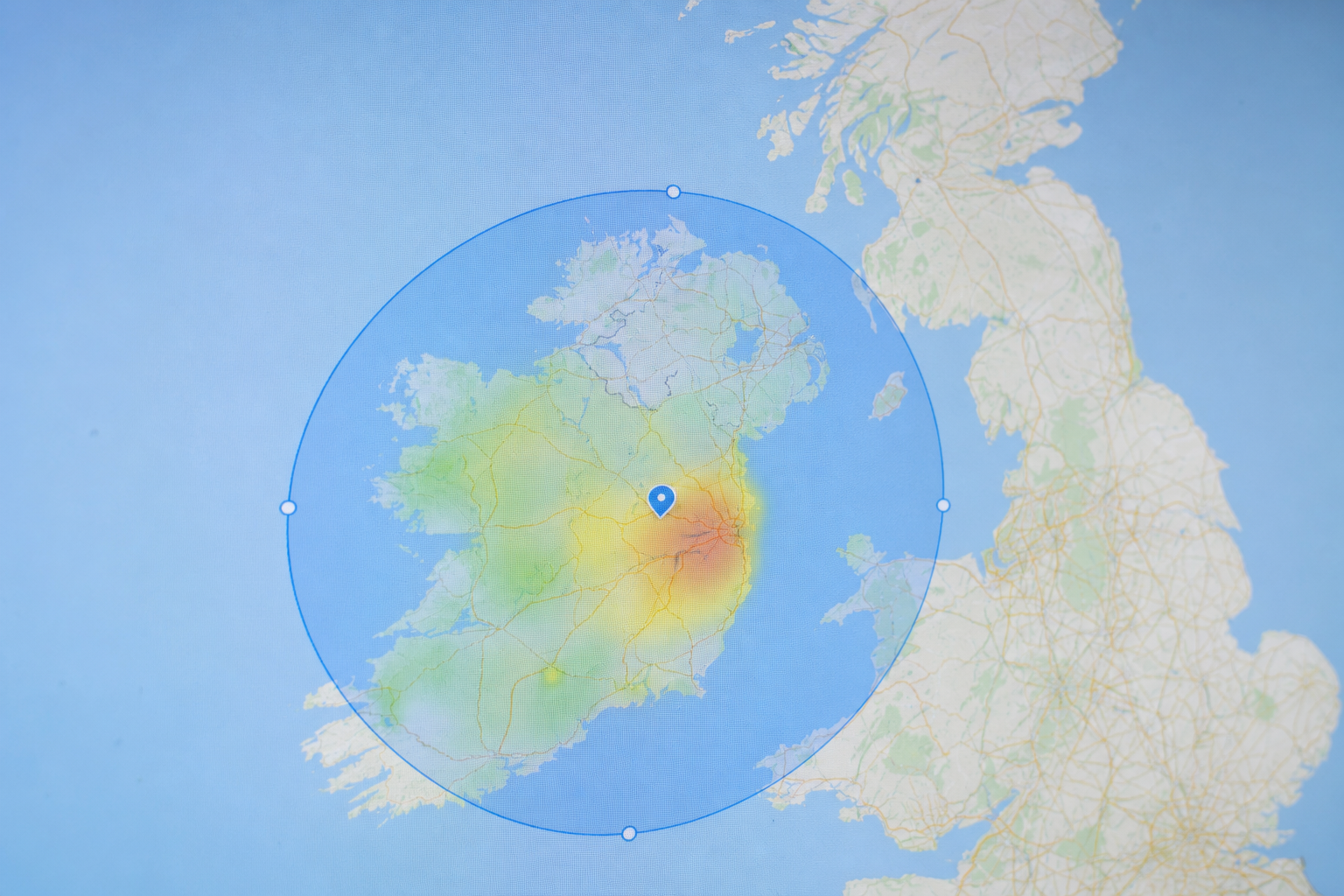
Because Ireland shares a language and a close border with the UK, sloppy location settings routinely serve Irish budgets to UK users who will never convert. Google's default "presence or interest" targeting is the usual culprit. In account audits we have found meaningful slices of a business's budget serving outside its actual service area with next to no conversions to show for it. Always set targeting to "presence" only, and exclude regions you cannot serve.
The Algorithm Learning Period Problem
Every new campaign goes through an algorithm learning period while the platform gathers conversion data. Underfund it or fiddle with it daily and you keep it stuck in learning, paying premium prices for weak placements. This is the single biggest reason micro-budgets fail. The fix is patience and enough spend: on one painting account we managed, leads roughly tripled and cost per lead more than halved across the first three months once the campaign moved out of the broad learning phase into tightly sculpted high-intent targeting.
VAT and Platform Billing: What Irish SMEs Must Know
This one catches nearly every first-time Irish advertiser. Meta and Google bill Irish business advertisers under the EU reverse-charge VAT mechanism. If you provide a valid VAT number, the platform does not add Irish VAT to your ad invoice; instead you self-account for it on your VAT return, reclaiming it in the same period so it nets to zero for most VAT-registered businesses. If you are not VAT registered, or you do not add your number, you can end up paying VAT on your ad spend that you cannot reclaim, quietly inflating your true cost per click by 23%.
The 2026 Irish Digital Ad Landscape: What Is Changing
Two shifts are reshaping how Irish SMEs should think about ad spend this year.
Cookie Deprecation and First-Party Data
Third-party cookies are fading and privacy rules are tightening, which makes your own first-party data the most valuable asset you have. Email lists, phone numbers and past-customer records now power the best-performing audiences on both Google and Meta. Irish SMEs that have been collecting and organising customer data will out-target those relying on borrowed tracking. If you are not building a first-party list yet, that is a bigger 2026 priority than your next campaign tweak.
AI-Driven Campaign Tools
Google Performance Max and Meta Advantage+ let a business with a €1,000 monthly budget access the same automated bidding and targeting muscle as a national brand, which genuinely levels the field. The pace of change in digital commerce, particularly the rapid deployment of AI, is transforming how businesses discover and buy, and businesses in Ireland need to be equipped to capture that growth. The risk is ceding control too early: hand a fresh account entirely to AI automation before you have clean conversion data and it optimises toward the wrong signals. Feed it good data first, then let it run. Our 2026 AI marketing playbook for Irish businesses covers where automation helps and where it hurts.
A Phased Monthly Ramp-Up Model: Month 1 to Month 6
Ad spend is not a switch, it is a ramp. Here is the phased model we use when we take on fully managed advertising in Ireland for a new client, with the expected algorithm status and focus for each phase.
Foundation and learning
Launch one focused campaign at your baseline spend. The algorithm is in learning; expect volatile costs and do not judge results yet. Get conversion tracking, call tracking and VAT billing correct now.
First real leads
Learning stabilises as conversions accumulate. A Wicklow-based trades business we managed saw qualified leads begin flowing in this window once the account had banked enough clicks to exit the broad learning phase.
Optimise and cut waste
Weekly negative-keyword work, geo-targeting tightening and audience refinement compound. This is where cost per lead typically starts falling hard, often more than halving from month one.
Add a second channel
With paid search stable, introduce remarketing or a Meta layer if budget allows, moving toward the 70/30 split. Each new channel restarts its own short learning period.
Scale what works
Shift budget toward the cities, audiences and keywords proving cheapest per genuine contact. On one account, named-city targeting revealed cost per lead varying roughly sixfold across suburbs, a clear signal of where to add spend.
Predictable pipeline
By now you have a stable cost per lead, a known ROAS and a defensible position in the auction. This is the point at which increasing budget reliably increases leads rather than just spend.
When to Scale Your Ad Spend (ROAS and Lead Volume Signals)
The single decision rule: add budget when the maths already works, fix the account when it does not. Scale up when your return on ad spend clears your target with room to spare, your cost per lead is stable across several weeks, and you are consistently limited by budget rather than by demand, meaning your ads are being throttled because you run out of money before the day ends.
Pause and fix instead when cost per lead is climbing, your impression share is capped by budget on weak terms, or your ROAS sits below break-even. Throwing money at a leaky account only makes it leak faster. And never judge on a single month: one of our accounts swung from a 3.4% conversion-rate month to a 13.9% month within the same campaign, which is exactly why you scale on trends, not on one report.
Frequently Asked Questions
What is the ad spend prediction for 2026?
Digital advertising costs are rising into 2026. Cross-industry Google Search CPCs climbed roughly 12% year over year, partly as advertisers move budget into paid search to offset organic clicks lost to AI Overviews. For Irish SMEs, the practical prediction is that the same result costs a little more than last year, which makes account efficiency, not just budget size, the deciding factor.
How much should a small business spend on advertising in Ireland?
As a starting benchmark, allocate 5 to 10% of revenue to marketing, with roughly half to two-thirds of that as working ad spend. In hard numbers, most Irish SMEs treating ads as a real lead source land between €500 and €2,000 a month, with growth-stage businesses running €2,000 to €5,000. Under €500 a month buys data and learning rather than reliable results.
What are the small business predictions for 2026 in Ireland?
Digital maturity is the defining theme. Digital Business Ireland found that doubling SME digital investment could add €8.3 billion to the economy, and projected further growth in digital commerce through 2026. Expect AI-driven campaign tools, first-party data and privacy-compliant targeting to separate the Irish SMEs that grow online from those that stall.
What is the 70/30 rule in marketing?
In this ad-budget context, the 70/30 rule means putting about 70% of your paid budget into the channel that captures existing demand, usually Google Ads for lead-gen, and about 30% into the channel that creates new demand, usually Meta. E-commerce businesses often shift closer to 50/50 or lead with Meta. It is a starting split you refine with your own performance data, not a fixed law.
What is the minimum ad spend threshold before Irish SMEs see real returns?
In our experience, roughly €500 a month on a single focused channel is the realistic floor for treating paid ads as a lead source rather than an experiment. Below that, campaigns struggle to escape the algorithm learning period, so you pay premium prices for weak results. The threshold rises for professional services and B2B, where higher CPCs mean €1,000 or more is often needed to gather enough data.
Want your ad spend calibrated, not guessed?
We manage Google Ads and Meta campaigns for Irish small businesses, with monthly reporting on real spend, cost per lead and ROAS, and no long lock-in contracts. If you would rather your budget compounded than leaked, let us take a look.